Custom and biodegradable implants: what patents tell us about the future of orthopedics
3D printing is not just changing the way orthopedic implants are manufactured: it is redefining what an implant can do, how long it lasts, and how much intervention it requires from the patient. Thanks to hybrid production techniques and biodegradable materials, customized orthopedic implants could soon offer greater safety and less invasiveness, without having to wait decades to get there.
Cited patents
- ADDITIVE MANUFACTURING ON MACHINED ASSEMBLED PARTS — January 28, 2026
- SCAFFOLD WITH STEM CELLS — March 18, 2026
What problem does it solve
Traditional orthopedic implants often require multiple interventions and do not integrate perfectly with the patient's bone.
In the field of orthopedic and trauma surgery, one of the most common problems is the need for a second surgical procedure to remove plates, screws, and fixation devices after the bone has healed. This procedure exposes the patient to additional risks, increases healthcare costs, and lengthens overall recovery times. The ideal solution is a temporary implant capable of mechanically supporting bone tissue during the healing phase and then gradually dissolving in the body, eliminating the need for a second operation.
Parallelly, the surface quality of 3D printed implants is often lower than that obtainable with traditional machining techniques, which can compromise the assembly of complex components and integration with bone tissue. While 3D printing allows for the creation of porous structures that promote bone growth, mechanical machining ensures precise and reliable surfaces. Combining the two approaches could offer the best of both worlds.
The idea in 60 seconds
By combining pre-machined mechanical parts with 3D printed porous structures, highly integrable and customized implants are obtained.
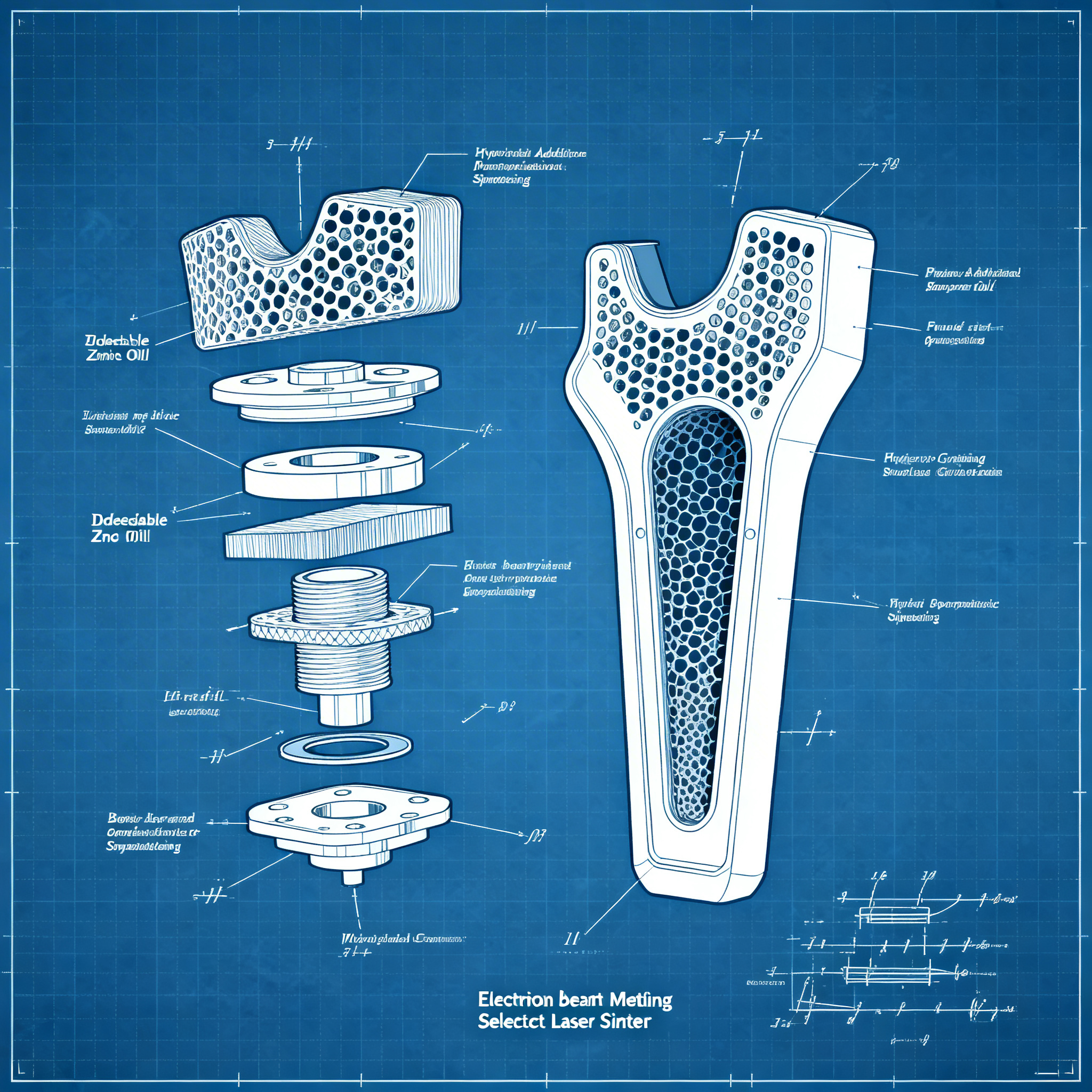
The patent ADDITIVE MANUFACTURING ON MACHINED ASSEMBLED PARTS describes a hybrid process: first, solid components manufactured with traditional techniques (turned, milled) are assembled, then a porous structure is 3D printed directly onto them. The result is a device that integrates the mechanical precision of machined parts with the geometric flexibility of additive manufacturing.
The device may include a central opening with straight and curved sides, segments with coaxial holes for intraoperative imaging instruments, and a solid external structure printed around a porous core to ensure structural integrity. The internal hollow region can be filled with bone graft to accelerate fusion and bone growth. The porous part can be made of porous titanium with a solid external titanium frame for reinforcement, using technologies such as electron beam melting (EBM), selective laser sintering (SLS) or selective laser melting (SLM).
On the front of biodegradable materials, zinc occupies an intermediate position between magnesium (which degrades too quickly) and iron (too slow): it has a degradation rate compatible with the biological times of bone healing, is naturally present in the human body and participates in fundamental cellular functions such as the immune response and bone mineralization.
The patent SCAFFOLD WITH STEM CELLS proposes instead a radically different approach: a scaffold composed of 60% biomaterial (silicone, poliglycolic acid, xanthan gum, NaCl, agar, carbon fullerene C60 and water) and 40% cellular materials, mainly mesenchymal stem cells of adipose origin (50%), hyaluronic acid (30%) and TGF-beta (20%). The material has a rubbery consistency and can be stimulated from the outside to promote cell growth, progressively replacing the biodegradable material with biological tissue.
What really changes (tangible improvements)
Mechanical precision + geometric flexibility = better bone integration and fewer post-operative revisions.
The hybrid approach described in the first patent improves the precision of critical surfaces thanks to the use of pre-machined mechanical components, while allowing complex internal geometries without sacrificing robustness. The fillable cavities for bone graft accelerate fusion, while the porous structure promotes osteointegration. This means fewer post-operative complications and better mechanical load distribution.
A study published in March 2026 in the Journal of Functional Biomaterials investigated the feasibility of producing custom biodegradable implants from zinc alloys with silver and copper, using laser powder bed fusion (L-PBF) 3D printing technology. The study, conducted by the University Hospital of Tübingen and the fem Research Institute of Schwäbisch Gmünd, tested three alloys: ZnAgCu, ZnAgCuMn and ZnAgCuTi.
The ZnAgCuMn alloy proved to be the one with the best biological performance in fresh polished samples, thanks to the lower release of Zn²⁺ ions and the co-release of small amounts of Mn²⁺, which the literature associates with positive effects on osteoblast proliferation. The ZnAgCuTi alloy, on the other hand, consistently showed the lowest biological performance.
A critical aspect emerging from the study concerns superficial aging: polished samples stored in air for 3 months showed significantly lower cytocompatibility compared to fresh polished samples. For ZnAgCu, proliferation decreased from 36.21% (fresh) to 8.31% (aged); for ZnAgCuMn from 56.61% to 42.91%. This indicates that implant packaging, sterilization, and storage strategies will have a direct impact on the biological response.
Regarding cellular scaffolds, the ability to degrade in situ reduces the need for secondary interventions, while the programmed release of growth factors promotes a controlled biological response. However, available sources do not provide quantitative data on degradation times or clinical success percentages.
Example in company / on the market
Today, some surgical centers are already testing hybrid prototypes in the operating room.
The New York-based company Himed has developed an innovative hydroxyapatite (HA) surface finishing process for the market of 3D-printed medical implants. Hydroxyapatite is a natural calcium phosphate found in bones and teeth, commonly used as a blasting medium for surface preparation and as a coating to encourage osseointegration.
Himed's process uses hydroxyapatite as a blasting medium that can both remove unwanted residual beads from powder-based 3D prints and improve the biocompatibility of printed medical devices. Unlike aluminum oxide, traditionally used but prone to fragmentation and incorporation into the material, HA can be completely removed with a passivation process, leaving only a clean surface.
OsseoLabs, a company that combines AI-guided surgical planning with next-generation bioresorbable implants, is already testing magnesium bioresorbable implants that provide mechanical support only during the critical healing phase and then safely resorb. OsseoMatrix™ TPMS (Triply Periodic Minimal Surface) architectures promote superior bone growth and reduce stress shielding. The OsseoVision™ system allows surgeons to digitally plan the procedure, review fixation strategies, and confirm implant placement in advance, often reducing operating times by 30-50% in complex cases.
Materialise has recently launched CMF (cranio-maxillo-facial) implants
article written with the help of artificial intelligence systems
Q&A
- What are the main problems of traditional orthopedic implants according to the article?
- Traditional orthopedic implants often require multiple interventions and do not integrate perfectly with the patient's bone. In particular, a second surgical intervention is needed to remove plates, screws, and fixation devices after bone healing, exposing the patient to additional risks, increasing costs, and prolonging recovery times.
- What does the patent ADDITIVE MANUFACTURING ON MACHINED ASSEMBLED PARTS propose?
- This patent describes a hybrid process that combines pre-machined mechanical components with 3D printed porous structures. The approach allows for the creation of custom implants that integrate the mechanical precision of traditional parts with the geometric flexibility of additive manufacturing, improving bone integration and reducing the need for post-operative revisions.
- Why is zinc considered a promising material for biodegradable implants?
- Zinc has a degradation rate compatible with the biological times of bone healing, is naturally present in the human body and participates in fundamental cellular functions. Studies show that zinc alloys with silver and copper can offer good biological performance, with the controlled release of ions that favor the proliferation of osteoblasts.
- What does the SCAFFOLD WITH STEM CELLS patent deal with?
- This patent proposes a scaffold composed of 60% biomaterial and 40% cellular materials, mainly mesenchymal stem cells. The material, with a rubbery consistency, can be stimulated from the outside to promote cell growth, gradually replacing the biodegradable material with biological tissue, reducing the need for secondary interventions.
- Which companies are already active in the advanced orthopedic implant sector?
- Himed develops hydroxyapatite finishing processes to improve biocompatibility; OsseoLabs uses biodegradable magnesium implants and TPMS architectures to promote bone growth; Materialise produces custom cranio-maxillo-facial implants with AI-guided digital planning technologies.