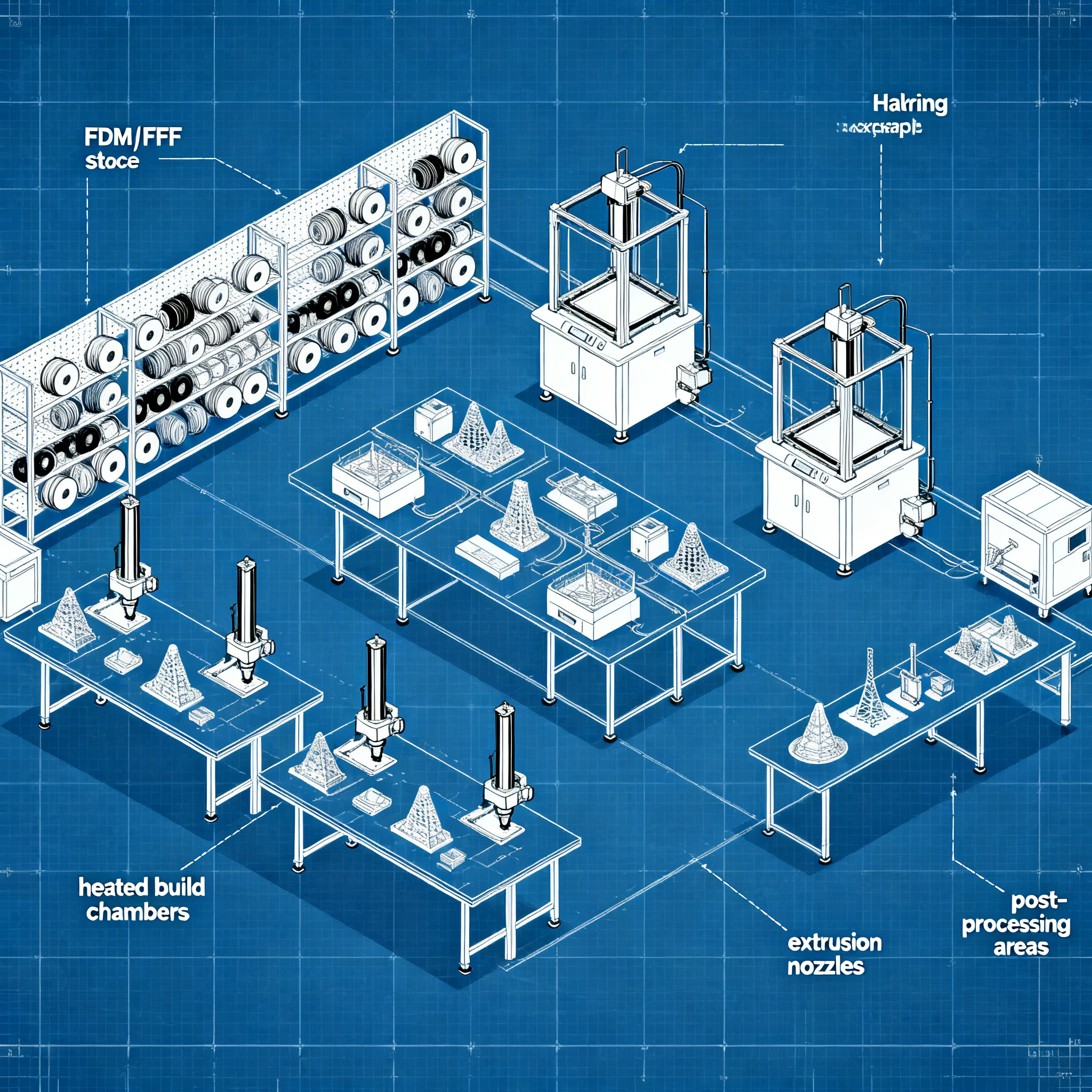
How to Design a High-Volume 3D Printing University Makerspace
The University of Wisconsin–Madison has redefined its Makerspace to turn it into a true teaching-industrial laboratory, capable of managing thousands of 3D prints per year without compromising quality and timelines. The secret to its success lies in three fundamental pillars: a standardized workflow for job management, a coherent technological selection based exclusively on FDM/FFF, and a hybrid team of students and qualified technicians that ensures operational continuity.
The UW–Madison Makerspace, part of the Grainger Engineering Design Innovation Lab, is now a reference model for anyone wanting to design a university laboratory that can effectively support courses, research, and student projects through additive production. With over 3,000 parts already printed in the 2018-2019 period and volumes constantly growing, the university has demonstrated that it is possible to scale operations while maintaining high efficiency and quality.
Standardized Workflow for 3D Print Management
An organized system allows for managing hundreds of weekly jobs without a hitch, improving reliability and reducing waiting times for students and researchers.
The central element of the modernization of the UW–Madison Makerspace is the introduction of a completely internal job management system, which covers the entire cycle from material choice to post-processing. The laboratory has implemented standardized procedures for file loading, machine setup, and the collection of finished parts, eliminating bottlenecks and drastically reducing downtime.
The system provides an area dedicated exclusively to 3D printers, where the staff, composed of students and technicians, supports users at every stage of the process. This configuration allows for managing a high volume of prints thanks to desktop FDM/FFF systems alongside professional machines capable of working continuously. The standardization of processes has made the deadlines for teaching and research projects more predictable, a crucial aspect when thousands of students depend on access to printing resources.
The integration of the Makerspace into the college's official courses has further strengthened the workflow: students can move from CAD modeling to the fabrication of mechanical prototypes, the integration of sensors and electronics, up to IoT solutions or complete robotic systems, all within the same operational ecosystem.
Coherent Technological Selection with Educational Objectives
The exclusive use of FDM/FFF technologies allows for maintaining a teaching and operational focus, avoiding resource dispersion and unnecessary management complexity.
UW–Madison's technological strategy stands out for its consistency: the laboratory has chosen to focus on a heterogeneous fleet of 3D printers based on FDM/FFF technology, from desktop platforms to professional systems. This choice is not random, but responds to precise educational and productive objectives.
The new modernization plan has seen investment in faster 3D printers with larger volumes, with optimized hotends and work chambers for printing technical materials. The machine range has been selected to cover a wide variety of use cases: rapid concept models, functional components for robotics and mechatronic devices, enclosures for electronics, models for aerodynamic or fluid dynamic testing, and parts for biomedical prototypes.
Maintaining technological consistency has allowed for the optimization of staff training, reduced maintenance costs, and simplified material management. Students acquire in-depth skills on a specific technology rather than superficial knowledge of multiple incompatible systems. This focus results in a faster learning curve and greater operational autonomy for users.
Human Resources Management in the Makerspace
A hybrid team of students and qualified technicians ensures operational continuity and professional growth for users, transforming the Makerspace into an experiential learning environment.
The human resources management model adopted by UW–Madison represents a strategic balance between technical expertise and accessibility. The staff is composed of qualified technicians who ensure operational continuity and trained students who provide peer-to-peer support, creating a collaborative learning environment.
This hybrid structure offers multiple benefits: technicians ensure that machines are always operational and that complex processes are managed correctly, while student staff develop transferable professional skills and help their colleagues overcome the initial learning curve. The model also favors scalability: with increasing volumes, it is possible to train new student staff without necessarily increasing permanent technical personnel.
The Makerspace also organizes open workshops on thermoforming techniques, light CNC machining, laser cutter use, and advanced use of 3D printers, expanding the skills of the university community. The presence of an area equipped with 3D printers, scanners, electronics, and welding stations favors interdisciplinary projects and the integration of different technical skills.
An Intelligent Ecosystem for University Innovation
A well-structured makerspace is not just a physical space equipped with tools, but an intelligent ecosystem that connects training, innovation, and production in an organic way. The experience of UW–Madison demonstrates that the key to success lies in the integration between standardized workflows, consistent technological choices, and strategic human resource management.
The investment in strengthening the Makerspace is part of the university's broader strategy to support experiential learning and applied research. The laboratory, hosted in Wendt Commons, was conceived as a space where every engineering student can explore ideas, validate concepts, and build physical prototypes without excessive cost or access barriers. The university ecosystem already sees entrepreneurial realities like Zero Barrier Labs, engaged in the development of low-cost metal 3D printers, which leverage the Makerspace's skills and infrastructure to rapidly iterate on their projects.
Start immediately defining your integration plan between teaching and digital production: start with a simple workflow, select technologies consistent with your training objectives, and scale gradually by investing in staff training. High-volume additive manufacturing in the university context is not a question of how many printers you own, but how effectively you can integrate them into a sustainable and scalable operational system.
article written with the help of artificial intelligence systems
Q&A
- What are the three fundamental pillars of the University of Wisconsin–Madison Makerspace for managing a high volume of 3D prints?
- The three pillars are: a standardized workflow for job management, a consistent technology selection based on FDM/FFF, and a hybrid team of students and qualified technicians.
- How is the 3D printing workflow managed in the Makerspace?
- The workflow is fully internalized and standardized, covering all phases from file upload to post-processing. A dedicated area for the printers is provided with continuous support from students and technicians.
- Why did the Makerspace choose to focus exclusively on FDM/FFF technology?
- The choice aims to maintain a didactic and operational focus, simplifying management, reducing costs, and allowing students to acquire in-depth skills on a specific technology.
- What is the role of the hybrid team of students and technicians in the Makerspace?
- Technicians ensure operational continuity and manage complex processes, while students provide peer-to-peer support and develop professional skills, making the laboratory scalable and didactically effective.
- How many 3D prints were made in the period 2018-2019?
- In the period 2018-2019, the Makerspace managed over 3,000 3D prints, demonstrating the ability to operate at high volume without compromising quality and timelines.