
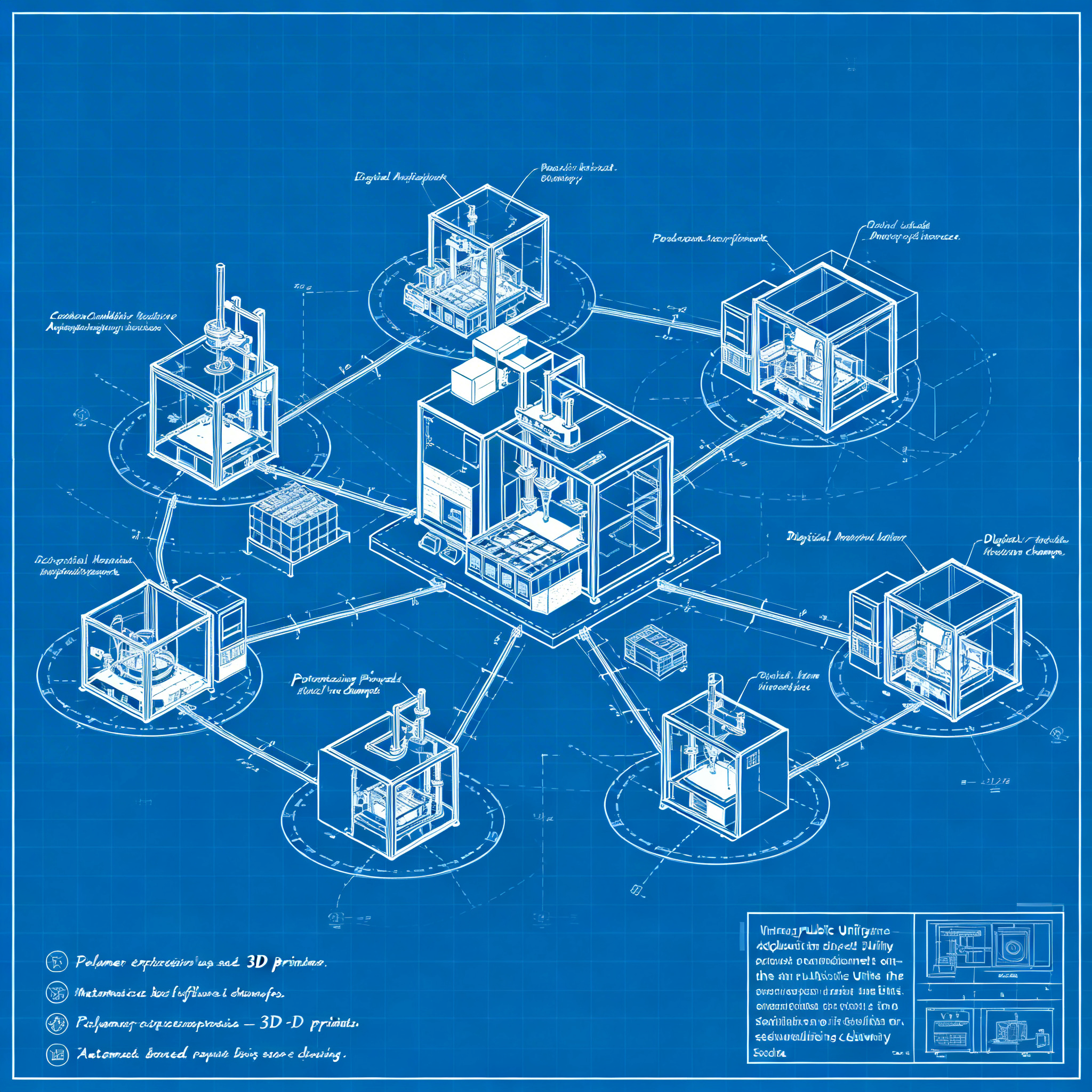
How Additive Manufacturing is Redefining the Regional Infrastructure for Resilient Public Services
Australia is transforming its supply chains thanks to additive manufacturing, focusing on intelligent and resilient local production.
In a global context characterized by geopolitical tensions and supply chain vulnerabilities, additive manufacturing (AM) emerges as a strategic tool for building more resilient regional infrastructure. The Australian experience, led by the Additive Manufacturing Cooperative Research Centre (AMCRC), offers a concrete operational model for integrating additive production into critical public services, from healthcare to defense, reducing dependence on foreign suppliers and strengthening local production capacity.
An Operational Plan for the Regional Integration of AM
The AMCRC has defined a structured operational framework to transform Australian research excellence into scalable and certifiable industrial production capacity.
Australia consistently ranks fifth globally for scientific production in the field of additive manufacturing, with significant contributions from universities and CSIRO in areas such as advanced materials, process modeling, and qualification frameworks. However, the country has historically struggled to translate this academic leadership into large-scale, certifiable industrial production.
To bridge this gap, in 2025 the AMCRC was established with a federal investment of 57.5 million Australian dollars. The initiative brings together 13 Australian universities, the CSIRO, and over 60 industrial organizations to develop concrete commercial pathways, workforce training, and industry-oriented research. “As a nation, we are exceptionally good at innovation,” says Simon Marriott, Managing Director of the AMCRC, “but too often our ideas do not translate into repeatable and certifiable production. That gap between research and implementation is where we must focus.”.
The AMCRC's operational model is based on three pillars: structured collaboration between industry and research, development of common standards for process qualification, and creation of shared infrastructures that allow SMEs to test, scale, and invest with confidence. This systemic approach recognizes that technology alone does not create production capacity: skills, integrated supply chains, modern infrastructures, and sustainable business models are needed.
Friendshoring: Reducing External Dependence with Local Capacities
The concept of friendshoring applied to AM creates production networks between reliable and aligned partners, reducing geopolitical risks without renouncing economic integration.
The term “friendshoring” gained relevance in 2022 when then US Treasury Secretary Janet Yellen described it as a strategy to work with “allies and partners” to strengthen economic resilience while maintaining the benefits of production integration. Unlike simple reshoring, friendshoring does not imply a withdrawal from global trade, but its reconfiguration around politically and economically reliable partners.
Additive manufacturing is particularly well-suited to this strategy thanks to its intrinsically digital, distributed, and collaborative nature. Projects can be transferred securely, production can be localized, and supply chains shortened. These characteristics make AM ideal for “friendshored” manufacturing networks, where trusted partners share capabilities and standards instead of competing exclusively on cost.
Australia materialized this approach in October 2025 with a bilateral agreement with the United States to secure supply chains for critical minerals and rare earths, supported by over 2 billion dollars in public investments towards a portfolio of 8.5 billion dollars in projects. This agreement, supported by the government strategy “Future Made in Australia” which commits 22.7 billion dollars over the next decade, reflects a paradigm shift towards building end-to-end value chains with reliable partners.
“Friendshoring allows Australia to integrate into global ecosystems where our research strengths complement industrial capacity,” explains Marriott. “It is about accelerating business outcomes through trusted partnerships.” For Australian SMEs, these networks offer pathways to qualification, production scale, and export markets that would otherwise be unreachable.
Case Studies: Health and Defense on the Front Line
Strategic sectors such as health and defense concretely demonstrate how regional AM can increase operational autonomy and emergency response capabilities.
The COVID-19 pandemic dramatically exposed the vulnerabilities of Australian supply chains, increasing interest in local production. In the health sector, AM demonstrated the capacity to rapidly produce essential medical devices, custom surgical tools, and prostheses on demand, reducing procurement times from weeks to days.
In the defense sector, AM is transforming the logistics of spare parts and equipment maintenance. The ability to produce components on-demand reduces the need for extensive warehousing and improves operational readiness. Australian companies such as SPEE3D, Titomic, Conflux Technology, and Additive Assurance have built solid international footprints while maintaining domestic engineering and production bases. Titomic, for example, operates production cells in Australia, Europe, and the United States, serving highly regulated sectors such as aerospace, defense, and energy.
The regional approach to AM for public services requires shared infrastructure, joint demonstration programs, and harmonized certification pathways. “In additive manufacturing, qualification and consistency are often the greatest barriers to adoption,” observes Marriott. “If we can validate processes between allied partners, we reduce the time necessary for new materials and technologies to reach the market. At the same time, we support workforce mobility through common standards, equipment, and digital platforms.”.
Conclusion
The strategic adoption of additive manufacturing at the regional level represents a turning point for the resilience of public services and critical supply chains, transforming research into concrete production capacity.
The Australian experience demonstrates that AM is not simply a production technology, but an enabler of systemic resilience when strategically integrated into regional infrastructures. The AMCRC model, based on industry-research collaboration, friendshoring, and a focus on critical sectors, offers a replicable path for other regions seeking to strengthen their production autonomy without isolating themselves from the global economy.
Emerging technologies such as AI-driven process optimization, digital twins, and secure data platforms are further strengthening the case for friendshored AM, improving transparency, intellectual property protection, and quality control through distributed networks. Sustainability is also becoming central to supply chain decisions: AM reduces material waste, enables lightweight designs, and supports localized production that lowers transportation emissions.
Regions that invest in AM infrastructure today will be better prepared to respond to future emergencies. The integration of additive manufacturing into public infrastructure is no longer a question of if, but of how and how quickly. Operational models exist, the technologies are mature, and the benefits for public service resilience are demonstrable. What is needed now is political will, coordinated investments, and collaboration between the public, private, and academic sectors to turn the promise of AM into concrete, lasting productive capacity.
article written with the help of artificial intelligence systems
Q&A
- What is the role of the Additive Manufacturing Cooperative Research Centre (AMCRC) in Australia?
- The AMCRC was established in 2025 with a federal investment of 57.5 million Australian dollars to bridge the gap between academic research and certifiable industrial production. It brings together 13 universities, the CSIRO, and over 60 companies to develop commercial pathways, training, and industry-oriented research.
- How does additive manufacturing contribute to the resilience of public infrastructure?
- Additive manufacturing reduces dependence on foreign suppliers, enables rapid local and on-demand production, and accelerates response in emergency situations. It is particularly useful in the healthcare and defense sectors for the production of medical devices and spare parts.
- What does 'friendshoring' mean and how does it apply to additive manufacturing?
- Friendshoring refers to the reconfiguration of supply chains around politically and economically reliable partners. In AM, it enables the creation of secure and collaborative production networks, sharing capacity and standards among allied countries, as demonstrated by the Australia-USA agreement in 2025.
- What are the main obstacles to the large-scale adoption of additive manufacturing?
- The main barriers are the lack of common standards, the difficulty of qualifying processes, and the poor integration between research and industry. The AMCRC aims to overcome them with shared infrastructure, certification pathways, and structured collaboration.
- How does AM support the sustainability of supply chains?
- AM reduces material waste thanks to additive manufacturing, enables lightweight designs, and favors localized production, decreasing emissions related to transport. It thus becomes a key tool for greener and more resilient supply chains.


