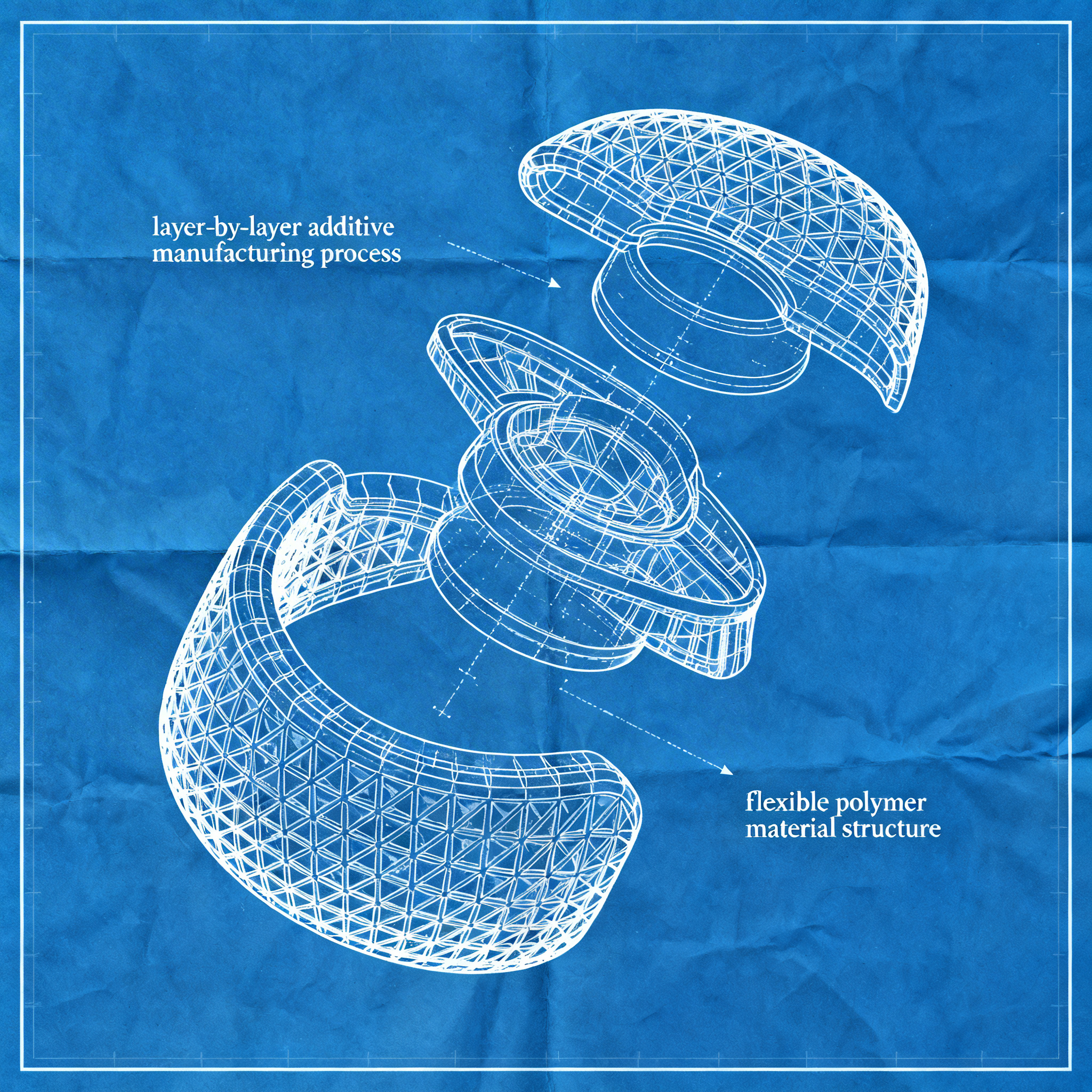
How 3D printing is revolutionizing wearable fashion: the AMISS case
The collaboration between Creality and the Australian brand AMISS demonstrates how 3D printing is concretely transforming fashion design, allowing brands to produce complex accessories and garments in a few hours instead of days, eliminating outsourcing and drastically accelerating the creative cycle.
3D printing is no longer just an experimental technology in the fashion industry: it is becoming a real productive tool. The case of AMISS, an Australian brand founded by siblings Vanessa and Josh, shows how integrating additive manufacturing into the creative workflow can reduce times and costs, while maintaining full control over the production process. Their participation in the WINGS Independent Fashion Festival in Sydney in May 2025 represented a concrete test bench for this innovative approach.
A new workflow for wearable fashion
The operational method adopted by AMISS eliminates dead times related to outsourcing production, allowing designers to rapidly iterate on prototypes and immediately correct any issues during the creative process.
The AMISS team has developed a completely digital workflow that starts from 3D modeling and goes directly to final production, without intermediaries. Using Creality 3D printers, designers can immediately print an accessory or clothing element just designed, verify its fit, and, if necessary, reprint it with modifications in very short times.
This approach replicates the principle of rapid prototyping used by the industrial sector for two decades, but applied to the fashion context. As highlighted by Creality, while rapid prototyping of mechanical components is established, its systematic application in the fashion world represents a significant innovation. It is no longer about creating unique pieces for conceptual fashion shows, but about integrating 3D printing into the normal operational workflow of a brand.
The process also includes the use of Creality Falcon laser systems for precise fabric cutting, combining complementary digital technologies. This integration allows greater accuracy compared to manual cutting and further speeds up production.
Case study: AMISS and Creality at the WINGS Festival
The preparation for the WINGS Independent Fashion Festival demonstrated how 3D printing can drastically reduce preparation times for live events, allowing designers to focus on creativity rather than production logistics.
Preparing for a major fashion event normally requires weeks of work and coordination with external suppliers. AMISS, however, used 3D printing to produce all necessary elements internally in just a few days. The team created accessories inspired by organic marine forms, printing them directly and then manually finishing them with paint to bring them to life.
Among the most significant pieces presented at the festival was a 3D-printed bustier: a large, thin element perfectly adapted to the model's body. This type of component, which traditionally would require expensive molds or intensive manual labor, was produced directly by the printer.
The ability to print, test, and reprint immediately allowed the team to correct any design problems without the typical delays of outsourced production. According to reports, this approach saved the team an enormous amount of time, a critical element when working with tight deadlines for live events.
The low cost of Creality equipment made this approach economically sustainable for an independent brand, whereas in the past it would have been necessary to invest in much more expensive machinery to obtain comparable quality results.
Competitive advantages for brands
The integration of 3D printing offers fashion brands the ability to respond rapidly to market trends, reduce production waste, and maintain full creative control, transforming the technology from a prototyping tool into a true production asset.
The AMISS model highlights measurable competitive advantages. First, the elimination of waiting times related to external production: instead of sending designs to a supplier and waiting days or weeks to receive samples, the brand produces internally in just a few hours. This drastically accelerates the product development cycle.
Second, the reduction of waste: 3D printing uses only the material necessary to create the object, unlike traditional subtractive processes that generate significant scrap. This aspect is particularly relevant in a fashion industry that is increasingly attentive to sustainability.
Third, the possibility of customization: each piece can be adapted to the specific measurements of the wearer without significant additional costs, opening up opportunities for business models based on mass customization.
Finally, creative control: designers maintain intellectual property and full control over the process, without relying on external suppliers who might not fully understand the creative vision or introduce delays.
According to Creality, this case demonstrates how 3D printing can introduce fundamental changes in an industry, just as it has in other manufacturing sectors. The technology does not completely replace traditional methods, but integrates into the production workflow to solve specific problems of time, cost, and flexibility.
Conclusion
The AMISS experiment represents a replicable operational model for fashion brands that want to innovate concretely, demonstrating that 3D printing can move from niche technology to a daily productive tool in the wearable sector.
AMISS's experience with Creality at the WINGS Festival is not only a technological demonstration, but a case study of practical implementation that other brands can study and adapt. The integrated digital workflow, from design to final production, offers a measurable competitive advantage in terms of speed, flexibility, and cost control.
While the fashion sector continues to explore the potential of additive manufacturing, cases like this demonstrate that the technology is mature for concrete professional applications, not just for conceptual runway pieces. The key to success lies in the systematic integration of 3D printing into the creative process, treating it as a daily productive tool rather than an occasional novelty.
Discover how your brand can adopt hybrid production solutions to remain competitive in the wearable fashion sector, reducing development times and maintaining full creative control over the production process.
article written with the help of artificial intelligence systems
Q&A
- What is the main advantage of 3D printing for wearable fashion according to the AMISS case?
- The main advantage is the drastic reduction in production times, which go from days to a few hours. This allows designers to iterate rapidly on prototypes and maintain full control over the creative process.
- How did AMISS use 3D printing during the WINGS Independent Fashion Festival?
- AMISS produced internally all the accessories and clothing elements necessary for the show in a few days, instead of the weeks normally required. They created complex pieces like a bustier inspired by marine forms, printing them directly and finishing them manually.
- What technologies has AMISS integrated into its production workflow?
- In addition to Creality 3D printers, AMISS has used Falcon laser systems for precise fabric cutting. This combination allows for greater accuracy, speed, and flexibility in the production of accessories and clothing items.
- How does 3D printing contribute to sustainability in the fashion industry?
- 3D printing reduces production waste because it uses only the necessary material to create the object, unlike traditional methods. Additionally, it allows for custom tailoring without significant additional costs, avoiding overproduction.
- Why does the collaboration between AMISS and Creality represent a paradigm shift in fashion?
- It is no longer about using 3D printing only for prototypes or conceptual pieces, but integrating it into the daily production workflow. This approach transforms the technology from an experimental tool into a true production resource.