Part Identification via CAD without ML Model Retraining
An innovative method directly exploits CAD models to automatically identify new parts, eliminating the need to retrain machine learning models. This revolutionary approach promises to transform part management in additive production, drastically reducing times and operating costs.
Researchers from KU Leuven, Materialise and Iristick have developed a system that allows to classify 3D printed parts never seen before by directly using CAD models, without having to retrain machine learning models from scratch every time a new category is introduced. The method focuses on the geometric representation of the object and on the capacity to adapt the classification system with a limited number of samples, solving one of the most complex challenges of modern additive production.
Evolution of Automatic Part Identification
Automation in the identification of mechanical parts has seen a gradual transition from manual methods to solutions based on machine learning, now further optimized thanks to the direct integration of CAD data.
In the field of additive production, automatically identifying the type of part, its function or its geometric family is fundamental for traceability, quality control and the management of the component lifecycle. Post-production identification represents a significant practical problem: often several parts are produced in a single printing session and subsequently collected together for subsequent processing. Once placed in a shared container, parts can lose the association with the original digital files, forcing technicians to sort and identify them manually.
Many existing recognition systems require large datasets of labeled objects and often work only on fixed categories, making it difficult to include new types of parts without expensive retraining. This significantly limits scalability and operational flexibility in modern production environments.
How CAD-based Recognition Works
The process extracts geometric features directly from CAD files, transforming them into vector representations ready for comparison through similarity models.
The proposed method starts from the assumption that CAD models explicitly represent surfaces, edges, features and geometric relations, information that is often lost if working solely on triangular meshes or on point clouds. Researchers extract a compact numerical representation (embedding) starting from the CAD, designed to capture the essential geometric traits that distinguish one class of parts from another.
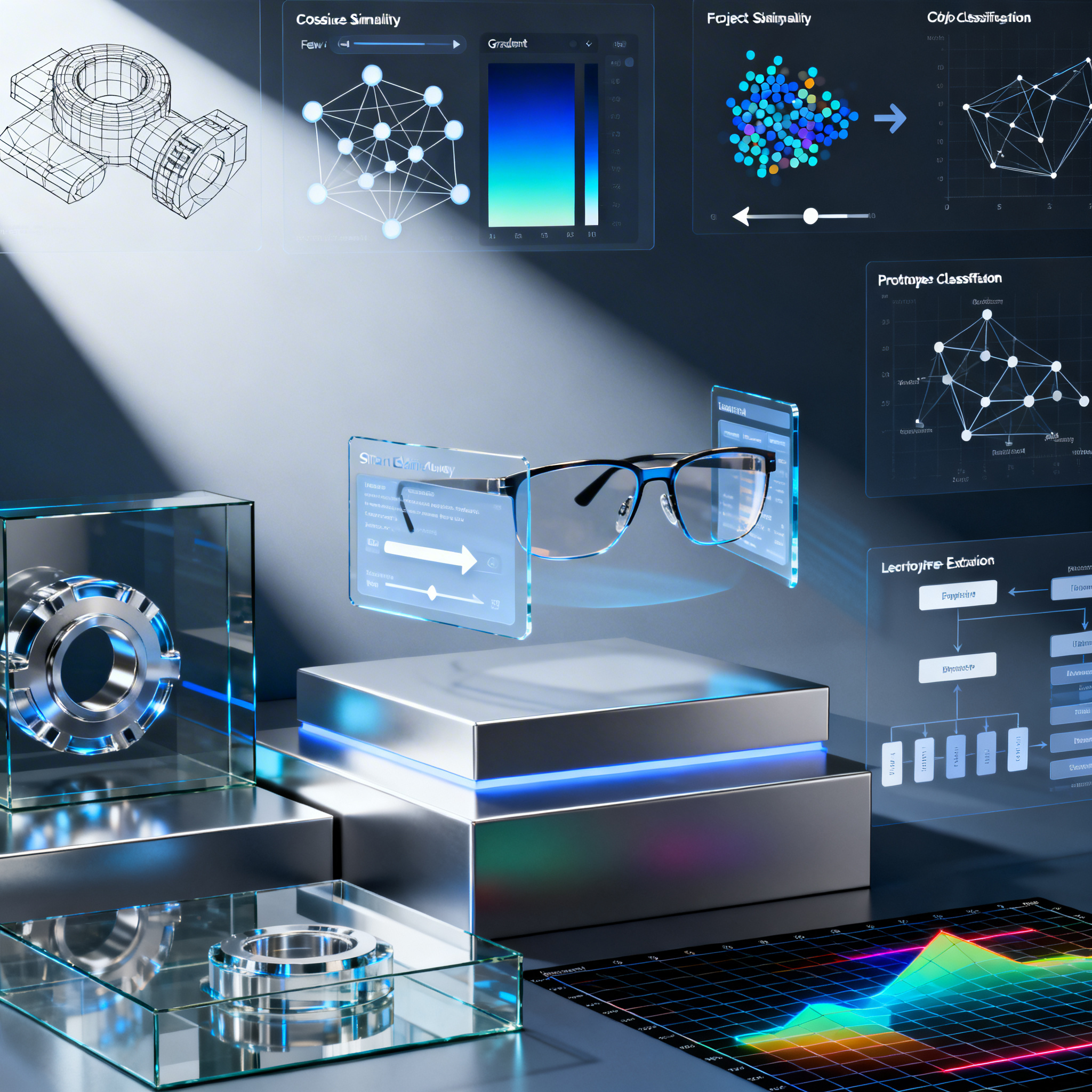
The classification process is formulated as a prototype-based approach, in which each object is represented by a feature vector derived from multiple rendered views of its model. During inference, a captured image is encoded into the same feature space and compared with these prototype representations using cosine similarity, with the closest match determining the predicted class.
In the described workflow, an operator wearing smart glasses picks up an object, captures an image, and receives identification support from a vision model. This design decouples the model from any fixed set of object categories, allowing it to operate on arbitrary collections of parts without additional training, provided the corresponding CAD models are available.
Few-Shot and Metric Learning in the CAD Context
Without requiring extensive datasets, the system leverages few examples to generalize new classes, maintaining high precision thanks to spatial embedding techniques.
The core of the work is a framework that allows adding new part classes to an already trained system by leveraging few-shot learning and metric learning techniques. Instead of updating all model parameters, the system builds new class prototypes in the feature space and uses distance metrics to assign unknown parts to the most appropriate category.
This approach significantly reduces computational cost and the risk of “catastrophic forgetting” of existing classes. The compact numerical representation extracted from the CAD makes learning new categories more efficient for an equal number of examples, allowing the system to generalize accurately even with limited samples.
To evaluate the performance of the approach, researchers used public datasets of 3D printable objects that include CAD models and associated meshes, with categories ranging from mechanical components to everyday objects. ThingiPrint was also introduced, a public dataset that pairs CAD models with photographs of their 3D printed counterparts, using 100 models randomly selected from the Thingi10K dataset.
Industrial Benefits and System Scalability
The approach allows for rapid integration of new components into the company catalog, reducing setup times and model maintenance costs.
This method eliminates the need to retrain a model every time a new part enters production, a crucial advantage for scalability in industrial contexts. The system enables more efficient management of the component lifecycle, improving traceability and reducing dead times associated with manual identification.
The approach reduces the time and costs associated with traditional training, allowing companies to rapidly introduce new parts into their catalog without significant investments in data collection and retraining. The ability to operate with few examples per class makes the system particularly suitable for productions characterized by high variability and small batches, typical of Industry 4.0.
The flexibility of the system makes it applicable to various additive manufacturing scenarios, from the identification of mechanical parts to the management of spare parts, with particular relevance for programs that require limited quantities of replacement parts where the cost per piece can be high.
Conclusion
Integrating CAD data directly into automatic identification systems opens up significant scenarios for Industry 4.0, with tangible benefits in terms of efficiency and operational flexibility. This approach represents a paradigm shift in the management of 3D printed parts, eliminating traditional barriers related to the costs and implementation times of machine learning systems.
Explore how your engineering department can benefit from this technology by integrating it into part management workflows. The adoption of CAD-based systems for automatic identification can radically transform production processes, improving traceability, quality control, and corporate competitiveness.
article written with the help of artificial intelligence systems
Q&A
- What is the main innovation of the described method for part identification?
- The main innovation consists of using CAD models directly to identify new parts without having to retrain machine learning models. This approach exploits the explicit geometric information of CADs to create comparable vector representations, eliminating the need for extensive datasets or costly training processes.
- How do CAD models contribute to improving automatic part identification?
- CAD models provide detailed geometric information such as surfaces, edges, and relationships between features, which are converted into compact numerical representations (embeddings). These allow the system to recognize and classify new parts based on their shape and geometric structure, even without having seen them before.
- What is the advantage of few-shot learning in this context?
- Few-shot learning allows the system to learn and recognize new part classes using only a few examples, drastically reducing the need for large datasets. This makes the system faster and less expensive to update, ideal for dynamic production environments with the continuous introduction of new components.
- What are the most relevant industrial benefits of the proposed system?
- The main industrial benefits include reduced setup times and costs, the elimination of model retraining, and greater flexibility in managing small-batch productions. Furthermore, it improves traceability and quality control, especially in contexts where rapid identification of different parts is necessary.
- How is artificial vision integrated into the identification process?
- An operator equipped with smart glasses captures an image of the physical part, which is then encoded into the same feature space as the CAD models. Through similarity measures, such as cosine similarity, the system compares the image with existing prototypes to identify the correct class of the part.