Bio-Based SLS Printing: When Sustainability Meets Technological Limits
Bio-based materials are making a strong entry into the 3D printing market, but to what extent can they really replace conventional polymers without structural or process compromises?
In March 2026, as the additive manufacturing industry accelerates towards more sustainable solutions, a clear fact emerges: bio-based materials for selective laser sintering (SLS) represent a concrete promise, but are still far from full technical maturity. The challenge is no longer to demonstrate that it is possible to print with renewable polymers, but to understand exactly where the performance limits lie compared to consolidated standards such as polyamide 12 (PA12).
State of the Art in Bio-Based Materials for SLS
The main families of biopolymers for SLS include polyhydroxyalkanoates (PHA) such as PHB and bio-based polyamides such as PA11, each with intrinsic characteristics that define their applicability and limits.
Polyhydroxybutyrate (PHB), a polyhydroxyalkanoate produced by bacteria as an energy reserve material, represents one of the most studied candidates for sustainable SLS. This bio-based and potentially biodegradable polymer, already used in packaging and biomedical fields, however, has a relatively narrow melting range and limited thermal stability – critical factors for powder bed processes where the window between melting and degradation determines processability.
On the polyamide front, Arkema's Rilsan® PA11 is derived from castor oil through renewable feedstocks and represents a more mature bio-based alternative, with mechanical properties closer to conventional materials. However, even in this case, the renewable origin does not automatically eliminate the typical process complexities of SLS.
Mechanical Properties: PHB-Biocarbon vs PA12
Direct comparison between PHB-biocarbon composites and standard PA12 reveals an increase in stiffness in bio-based materials, but at the cost of significant reductions in elongation at break and fatigue resistance.
Sintered PHB-biocarbon samples show an increase in stiffness and dimensional stability compared to pure PHB, thanks to the addition of carbon filler obtained from lignocellulosic biomass via controlled pyrolysis. This biocarbon, with high carbon content and porous structure, improves the thermal properties of the composite.
However, as is often the case with rigid polymer-filler composites, the increase in stiffness is accompanied by a possible reduction in elongation at break. Mechanical analyses on tensile and flexion specimens highlight that, while PHB-biocarbon can compete in terms of elastic modulus, it falls behind PA12 in applications requiring ductility and resistance to repeated impacts. This trade-off limits the use of bio-based composites to non-structural components or sectors where the priority is to reduce environmental impact rather than maximize long-term mechanical performance.
SLS Processability and Particle Cohesion
Selective laser melting of bio-based materials presents specific criticalities related to the narrow thermal process window and inter-particle adhesion, which require significant parametric optimizations.
The preparation of PHB-biocarbon powders requires grinding and classification to obtain a granulometric distribution suitable for thin-layer deposition, with particles in a dimensional range similar to polyamide materials. Analyses demonstrate that, within certain filler content intervals, it is possible to obtain a compromise between powder flowability and densification in the molten state.
However, excessively high percentages of biocarbon tend to reduce cohesion between particles and increase residual porosity. The thermal process window of PHB, narrower compared to PA12, limits operational flexibility and requires more precise control of laser parameters. The material's response to laser energy must be carefully calibrated to avoid thermal degradation or incomplete melting, factors that directly impact the industrial repeatability of the process.
Densification and Porosity in Bio-Based Prints
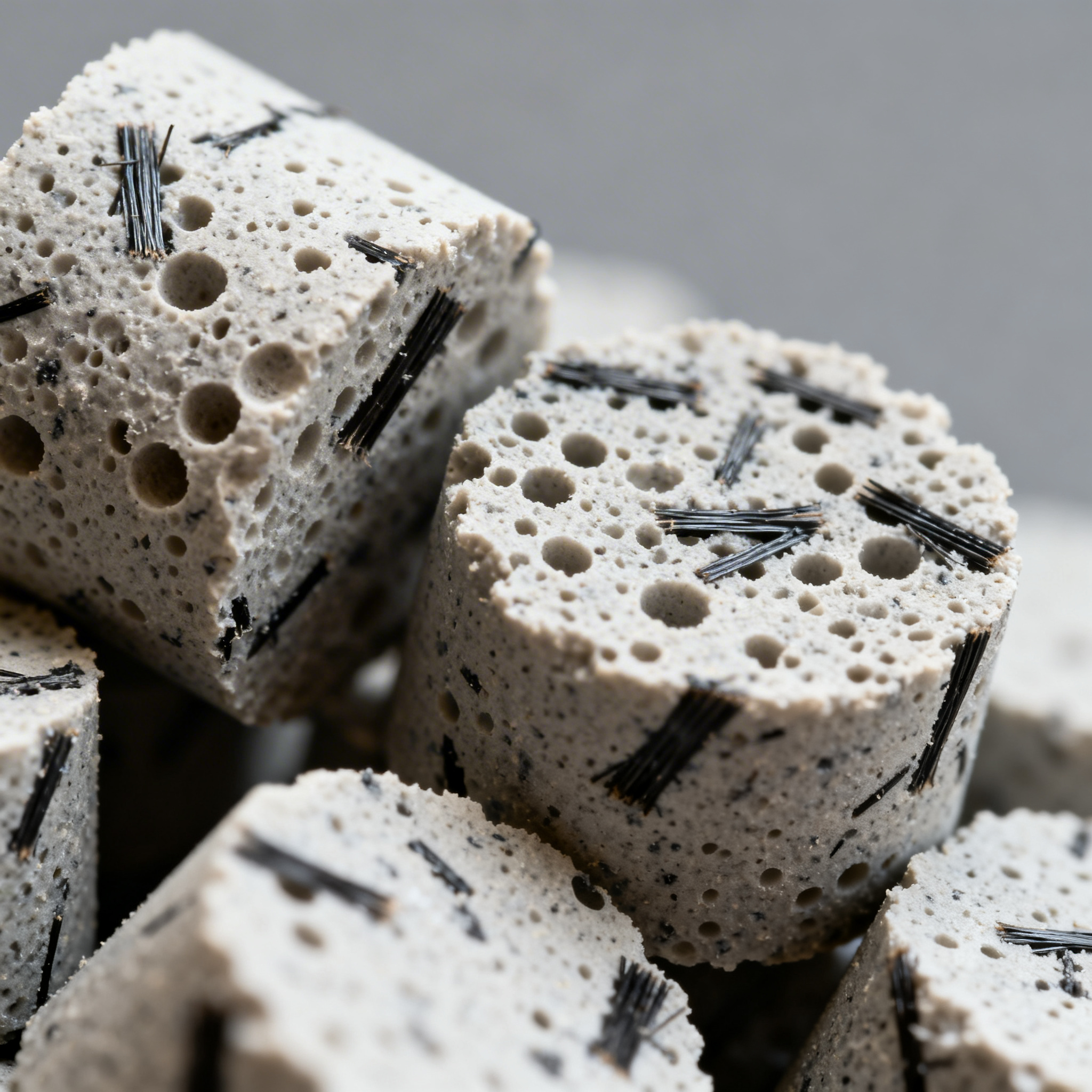
The microstructure of sintered PHB-biocarbon components reveals partially fused networks and inter-particle bond zones that directly influence the final functional properties.
Observation of the cross-section of printed samples highlights partially fused networks, particle bond zones, and filler distribution within the volume – elements that researchers directly correlate to the measured tensile and flexion properties. The internal quality of complex geometries made with sustainable materials represents a critical indicator of final functionality, especially for applications requiring fluid tightness, mechanical strength, or dimensional stability over time.
Residual porosity, higher in bio-based composites compared to conventional SLS materials, can compromise fluid tightness and reduce fatigue resistance. This aspect limits the applicability of bio-based materials to functional prototypes in the consumer sector, models for sustainable design, parts for temporary devices, or components where the sustainability narrative prevails over stringent performance requirements.
Real LCA: Environmental Balance Beyond the Source
The life cycle assessment of bio-based materials reveals that the environmental advantage over synthetic polymers depends heavily on production, transportation, and end-of-life conditions.
The production of conventional polyamides involves the use of fossil-based raw materials, whereas PHB can be obtained through fermentation processes utilizing biological resources, and biocarbon derives from biomass, with a potential benefit in terms of overall carbon footprint. However, the actual environmental balance must consider the entire production cycle, not just the material source.
Arkema's Virtucycle® program, which offers grades of polyamide 11 and 12 with certified recycled content, demonstrates that even conventional materials can achieve more favorable LCA profiles through circular economy strategies. Independent certification by SCS Global Services ensures that recycled materials maintain properties similar to virgin materials, with over 26 certified references.
For PHB-biocarbon composites, researchers hypothesize end-of-life scenarios based on biodegradability or controlled energy recovery, but it remains necessary to optimize composition, SLS parameters, and post-treatments to bring performance closer to the levels required by long-term functional components.
Conclusions
Despite progress in the formulation of bio-based materials for SLS, PHB-biocarbon composites still show significant room for improvement in terms of process reliability, densification, and mechanical performance compared to established industrial standards.
The path towards the complete replacement of conventional polymers requires not only materials from renewable sources, but also comparable performance, industrial repeatability, and verified environmental balances along the entire life cycle. Current applications of bio-based materials in SLS remain concentrated in niches where sustainability represents a differentiating value more than absolute structural performance.
Explore the comparative tests available at certified research centers to evaluate the industrial applicability of new bio-based feedstocks and understand if your use case can benefit from these emerging technologies.
article written with the help of artificial intelligence systems
Q&A
- What are the main bio-based materials used in selective laser sintering (SLS)?
- The main bio-based materials for SLS belong to the families of polyhydroxyalkanoates (PHA), such as PHB, and bio-based polyamides, such as PA11. PHB is produced by bacteria and is biodegradable, while PA11 derives from castor oil and has mechanical properties closer to conventional materials.
- What are the limitations of PHB compared to traditional materials such as PA12?
- The PHB presents a narrow melting window and limited thermal stability, which make it difficult to process in SLS. Additionally, although it increases stiffness when combined with biocarbon, it shows lower ductility and fatigue resistance compared to PA12.
- How does biocarbon influence the properties of the PHB-biocarbon composite?
- The addition of biocarbon improves the stiffness and thermal stability of the PHB, thanks to its porous structure and high carbon content. However, it can reduce the elongation at break and increase residual porosity, limiting its use to non-structural components.
- What are the main challenges in the processability of bio-based materials in SLS?
- The main challenges include the narrow process thermal window, the need to precisely control laser parameters, and poor inter-particle cohesion. High filler percentages can increase porosity and compromise densification.
- In which sectors are bio-based materials currently most suitable for SLS?
- Bio-based materials are most suitable for sectors where sustainability is prioritized over high mechanical performance, such as functional prototyping, sustainable design, temporary devices, and applications where environmental communication is a distinctive value.