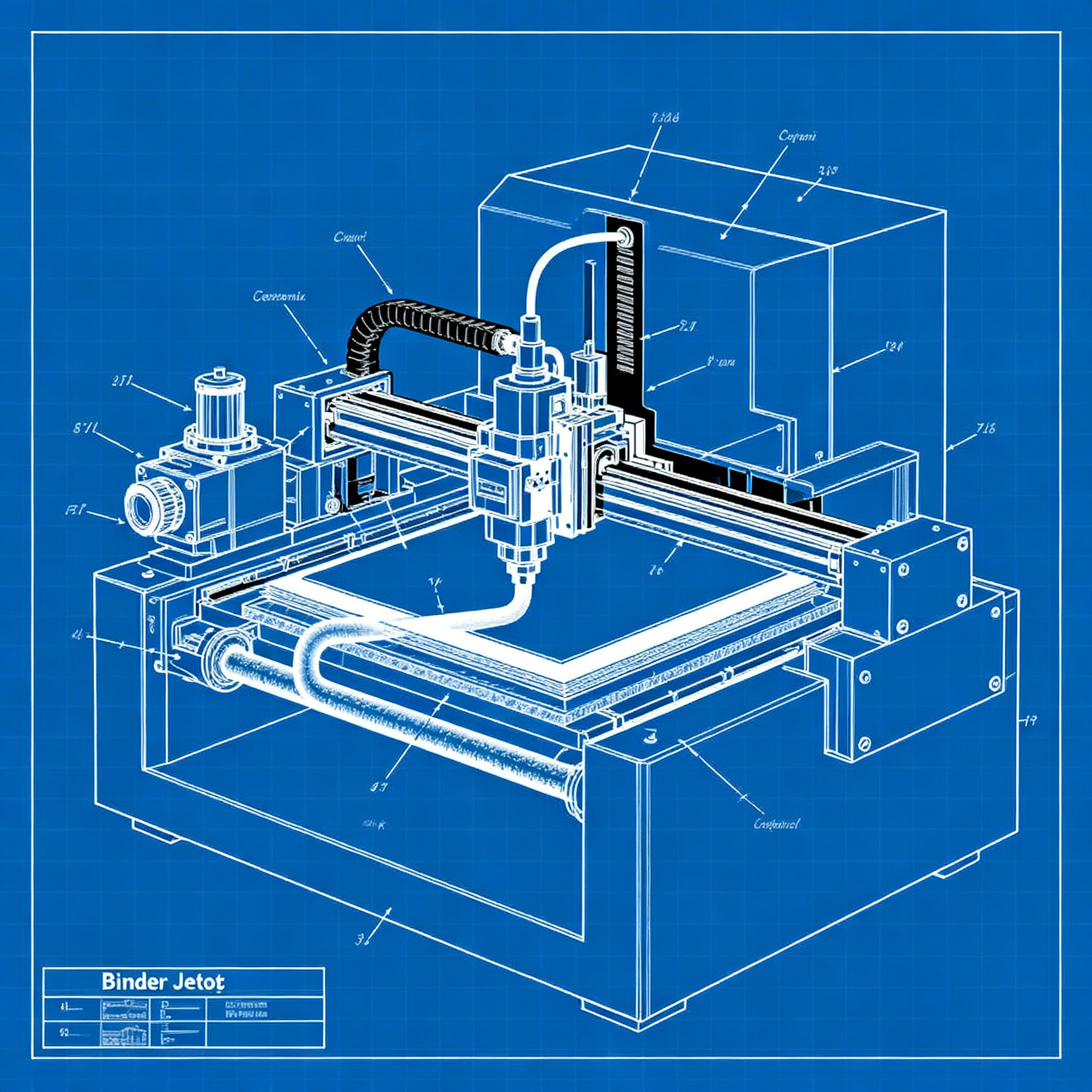
Industrial Binder Jetting with Ceramic Slurries: Mechanisms, Criticalities, and Advantages Compared to Powder Systems
The transition from laboratory to industry in ceramic binder jetting requires a thorough understanding of slurry dynamics and industrial processes that determine its reliability and scalability. The use of high-solid-concentration ceramic suspensions, rather than dry powders, introduces critical variables related to rheology and stability, but promises higher green densities, controlled shrinkage during sintering, and a more uniform material distribution, which are essential for the large-scale production of technical ceramic components.
Fundamentals of Ceramic Binder Jetting
Ceramic binder jetting selectively deposits a liquid binder onto material layers to define the part geometry, followed by drying, removal of unbound material, and final sintering.
In traditional binder jetting applied to ceramics, the material is typically a dry powder distributed in thin layers. The system selectively deposits a liquid binder to define the component geometry, followed by drying phases, removal of unbound powder, and sintering. This technology, already established in the metal industry with systems from Desktop Metal and ExOne, is also considered a natural candidate for ceramics due to its ability to handle high volumes, repetitive production cycles, and competitive per-part costs once the production flow is stabilized.
The process is based on an integrated triad of material, process, and sintering, where the feedstock formulation represents a critical element for final success. The effects manifest directly on density, deformations, and mechanical properties after sintering, making material tuning a central topic for the entire ceramic 3D printing supply chain.
Differences Between Dry Powder and Slurry: Technological Impact
The adoption of high-solid-concentration ceramic slurries introduces rheological and management complexity but enables higher green densities and more controlled material distribution compared to dry powder systems.
The use of ceramic slurries—suspensions of particles in a liquid vehicle—represents a significant evolution compared to dry powder. These systems potentially allow for higher green densities and more controlled material distribution, with a positive impact on final density and reduced shrinkage during sintering. In the Micro Particle Jetting (MPJ) process, for example, an aqueous suspension of ceramic powder and organics is used to build the green part. A high water percentage in the mixture means that, after drying, extensive pathways remain through the part for complete debinding before sintering.
However, this transition introduces additional variables related to rheology, sedimentation, and suspension stability. The useful process window depends on parameters such as particle size, particle size distribution, type of dispersant additives, and solid content. In the case of MPJ applied to silicon carbide, shrinkage during sintering is around 17%, a value that requires accurate compensation during the design phase.
Rheological Characteristics of Ceramic Slurries
The rheological properties of the slurry determine the quality of the deposition and the final product: viscosity, suspension stability, and particle size distribution must be optimized to ensure uniformity and repeatability.
From a rheological point of view, the slurry must maintain a viscosity compatible with uniform and repeatable deposition, avoiding both particle sedimentation and the introduction of defects such as bubbles or zones with variable concentration. In Micro Particle Jetting, ceramic particles are distributed with great uniformity to obtain an extremely homogeneous green body, a fundamental condition to avoid internal defects and dimensional variations during the sintering cycle.
The formulation of the slurry represents a critical element: studies on alternative feedstocks show how small variations in deposition parameters or in the thermal profile can lead to measurable differences in density, shrinkage, and functional properties. For this reason, manufacturers have developed optimized sintering profiles and specific monitoring systems for each material-process combination.
Challenges in Stability and Sedimentation
The stability of ceramic suspensions and sedimentation phenomena represent primary criticalities in industrial processing, requiring continuous agitation systems and constant monitoring of rheological parameters.
Bringing a ceramic slurry technology to industrial scale in binder jetting requires addressing process challenges that go beyond the pure laboratory concept. The stability of the suspension over time is a critical variable: particle sedimentation can cause concentration variations that lead to defects in the final part or production scrap.
In an industrial line, this translates into the need for continuous agitation systems, in-line viscosity monitoring, and procedures for feedstock maintenance and renewal. Upstream quality controls on the slurry batch become essential to ensure that each batch meets well-defined requirements before entering the machine. The development of stable and repeatable slurries is now recognized as a central theme for all ceramic 3D printing, as demonstrated by dedicated events and collaborations between universities and industry.
Infrastructure and Process Control
Industrial infrastructure for binder jetting with slurries requires advanced mixing systems, in-line monitoring, and thermal management, integrated with data analysis software to ensure repeatability and traceability.
System architecture for industrial production based on ceramic slurries must integrate dedicated hardware and software components. Digitalization plays a fundamental role in managing complex processes: monitoring and data analysis software allow for the detection of typical defects – such as slurry losses, incorrectly printed zones, or viscosity variations – and for targeted intervention before problems translate into scrap.
In the perspective of large-scale ceramic binder jetting, the combination of in-line sensors, analysis algorithms, and prediction models becomes a fundamental requirement to guarantee quality and traceability, similarly to what happens in industrial metal binder jetting flows and in other certified AM processes. Universities, such as the University of Applied Sciences and Arts of Southern Switzerland (SUPSI), are exploring the mechanical and chemical parameters that determine the success of innovative powder systems, using binder jetting as a research platform for the development of ceramic and metallic materials.
Attention has shifted from mere “printing technology” to the integrated triad of material-process-sintering, with a focus on high-solid-concentration ceramic slurries and design rules specific for shrinkage compensation. This systemic approach is essential to enable serial production of insulators, nozzles, exchangers, supports, and complex packages, with geometries difficult to realize via traditional methods.
Conclusion
Binder jetting with ceramic slurries represents a promising path for the industrialization of large-scale ceramic production, positioning itself alongside stereolithography, material jetting, and advanced extrusion techniques. Success will depend on the capacity to integrate stable slurry formulations, robust process control systems, and dedicated infrastructures that guarantee repeatability and compliance with regulatory requirements in regulated sectors. The possibility of scaling the technology to significant volumes could enable serial production in sectors such as power electronics, energy components, medical devices, and parts exposed to aggressive environments, where technical ceramics offer clear advantages over metals and polymers.
To implement this technology effectively, it is essential to invest in predictive models and automated monitoring systems, integrating expertise in materials science, process engineering, and digitalization to transform ceramic binder jetting from a niche technology into a consolidated industrial platform.
article written with the help of artificial intelligence systems
Q&A
- What are the main advantages of binder jetting with ceramic slurries compared to dry powder systems?
- Binder jetting with slurry allows for higher green densities, more uniform material distribution, and controlled shrinkage during sintering. These factors improve the quality and precision of components produced on a large scale.
- What critical variables does the use of high-solid-concentration slurries introduce in ceramic binder jetting?
- The use of slurry introduces criticalities related to rheology, suspension stability, and particle sedimentation. It is necessary to control viscosity, particle size distribution, and additives to avoid defects in the final product.
- How do the rheological properties of the slurry influence the quality of the final product?
- Rheological properties directly influence the uniform deposition of the material. Controlled viscosity and a stable suspension prevent defects such as bubbles or irregular areas, ensuring homogeneity and dimensional precision after sintering.
- What infrastructure and controls are necessary to scale binder jetting with ceramic slurries industrially?
- Advanced mixing systems, in-line viscosity monitoring, thermal management, and data analysis software are necessary. These elements ensure repeatability, traceability, and compliance with regulatory requirements demanded by the industry.
- In which industrial sectors could ceramic binder jetting with slurry have the greatest impact?
- This technology is particularly advantageous for sectors such as power electronics, energy, medical devices, and components for aggressive environments, where the precision and properties of technical ceramics offer benefits over metals and polymers.