
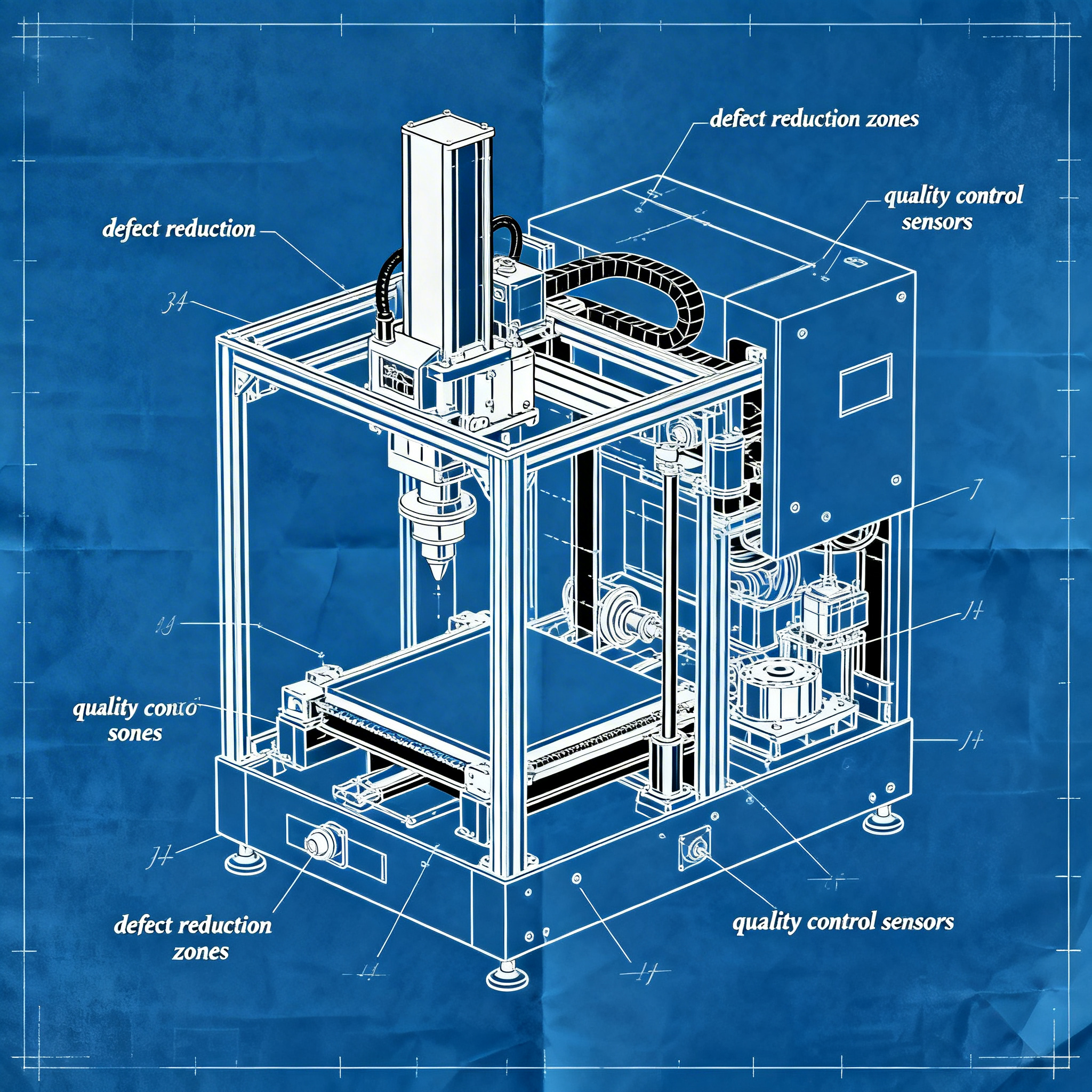
Industrial Performance Benchmarking: When 3D Printing Surpasses Traditional Manufacturing
A pilot project by the Electric Power Research Institute (EPRI) demonstrates that components produced with 3D printing not only compete with traditional ones, but in many cases surpass them in terms of internal defects and delivery times. Convergent manufacturing, which combines large-area Directed Energy Deposition (DED) with subsequent machining operations, has reduced production times from 30 months to 3 months for critical components in the energy sector, maintaining or surpassing the mechanical properties of traditional castings.
These results represent a turning point for the highly regulated manufacturing industry, where quality, reliability, and traceability are non-negotiable requirements. Systematic benchmarking between additive manufacturing (AM) and conventional methods is providing concrete data that accelerates industrial adoption, shifting the conversation from experimentation to qualified production.
Benchmarking Methodology: Criteria and Metrics
The comparison between components produced with 3D printing and traditional methods is based on rigorous evaluation criteria that include internal defects, production times, mechanical properties, and compliance with industrial standards.
The EPRI project adopted a rigorous methodological approach to compare components made with convergent manufacturing versus traditional castings. The evaluation included the analysis of material properties, the quantification of internal defects through non-destructive inspection techniques, and the verification of performance in simulated operating conditions.
Convergent manufacturing stands out for the integration of additive deposition and mechanical machining in a unified production flow. This methodology allows for the construction of complex geometries while maintaining tight dimensional tolerances in critical areas. The components underwent quality controls that included density analysis, microstructure verification, mechanical testing (tension, fatigue, creep), and inspections to identify porosity, lack of fusion, or cracks.
The calibration of measurement instruments and the adoption of traceable standards are fundamental elements to ensure that the collected data are comparable across different machines, materials, and production facilities. This approach responds to the industrial need to move from subjective monitoring systems to true in-process inspection systems that generate quantitative and repeatable data.
Production Times: From 30 Months to 3 Months
Data analysis demonstrates how convergent manufacturing can drastically reduce production times compared to traditional methods, with a documented reduction from 30 months to 3 months for critical components.
The EPRI pilot project required six months for the demonstration phase, but established a clear path for planned deliveries in just three months, compared to the 30 months required for components obtained via traditional casting. This reduction by a factor of 10 represents a significant competitive advantage for the energy sector, where the management of obsolete assets and the scarcity of qualified suppliers constitute critical challenges.
The production speed of AM does not compromise quality: the manufactured components have demonstrated material properties that are better or comparable to traditional castings, with a lower number of internal defects. This result is particularly relevant for applications where the replacement of critical components must occur rapidly to avoid prolonged operational disruptions.
Convergent manufacturing further mitigates supply chain risks by reducing dependence on complex and vulnerable global supply chains. For an industry that must guarantee increasing reliability and manage rising demand, this methodology could define the next era of large-scale component production.
Quality and Reliability: Reduced Internal Defects
Components obtained with additive manufacturing show mechanical properties comparable or superior to traditional castings, with a significantly lower number of internal defects.
The evidence collected in the EPRI project confirms that components produced with AM exhibit mechanical characteristics that meet or exceed the standards required for critical applications. Microstructure analysis and the quantification of internal defects revealed superior quality compared to conventional fusion methods, which are traditionally subject to porosity, inclusions, and other discontinuities.
The reduction of internal defects is attributable to the precise control of process parameters in AM, which allows for the optimization of material density and the minimization of imperfections. Advanced inspection techniques, such as computerized tomography and structured light metrology, allow for the identification and quantification of defects such as spatter (particles ejected during laser fusion) that affect surface roughness and porosity.
Studies conducted at the University of Louisville demonstrated a direct correlation between in-process measurements of surface roughness and the final porosity of components: regions with greater roughness and the presence of spatter exhibit higher porosity, while smoother areas produce denser parts. This capability to link quantitative in-process measurements to final quality represents a fundamental step towards the industrial qualification of AM.
Challenges in Large-Scale Adoption
The widespread implementation of AM in regulated industrial contexts depends on the ability to replicate these performances in complex operational environments, addressing regulatory, qualification, and production management aspects.
Despite promising results, the widespread adoption of AM in high-regulation sectors such as energy, aerospace, and defense requires overcoming significant barriers. The qualification of AM processes for safety-critical components implies the definition of validated process windows, rigorous controls on metal powder (particle size distribution, contamination, oxygen, humidity), standardized post-processing treatments, and clearly defined acceptance criteria.
Post-process inspection can represent more than half the cost of a qualified AM component, and in some cases becomes physically impossible for large-scale aerospace components. The transition from subjective monitoring systems to calibrated and traceable inspection methods is essential to reduce costs and increase confidence in the process.
The standardization of metallic data and integration with reference databases such as MMPDS (Metallic Materials Properties Development and Standardization) are necessary steps to accelerate industrial scalability. These standards reduce the risk of project-by-project reinterpretation and clarify requirements, responsibilities, and verification criteria throughout the supply chain.
Conclusion
3D printing proves to be a competitive technology for the high-regulation manufacturing industry, with documented benefits in terms of production times, component quality, and reduction of internal defects. The success of widespread adoption depends on the ability to maintain high standards in complex operational environments, through rigorous qualification methodologies, calibrated in-process inspections, and integration with existing industrial standards.
Companies should consider targeted pilot projects to test the applicability of AM in their critical production processes, evaluating not only technical performance but also integration with quality systems, regulatory compliance, and long-term economic sustainability. Convergent manufacturing represents a concrete opportunity to reduce supply chain risks and accelerate response times in sectors where reliability is non-negotiable.
article written with the help of artificial intelligence systems
Q&A
- What are the main advantages offered by 3D printing compared to traditional manufacturing according to the EPRI project?
- 3D printing drastically reduces production times from 30 months to 3 months and improves component quality, with fewer internal defects and mechanical properties comparable to or superior to traditional methods.
- What is meant by 'convergent manufacturing' and how does it improve production?
- Convergent manufacturing combines large-area Directed Energy Deposition (DED) with subsequent machining operations. This approach allows for the realization of complex geometries while maintaining tight tolerances and reducing overall production times.
- What techniques are used to ensure the quality and compliance of components produced with 3D printing?
- Density analysis, microstructure verification, mechanical tests (tension, fatigue, creep) and non-destructive inspections such as computerized tomography are used to identify any internal and surface defects.
- How does systematic benchmarking contribute to the industrial adoption of 3D printing?
- It provides objective and comparable data between production methods, allowing the transition from experiment to qualified production and accelerating the integration of additive manufacturing in regulated sectors.
- What are the main challenges for the large-scale adoption of 3D printing in highly regulated sectors?
- The main challenges include rigorous process qualification, metal powder control, inspection standardization, high post-processing costs and integration with existing regulations.


