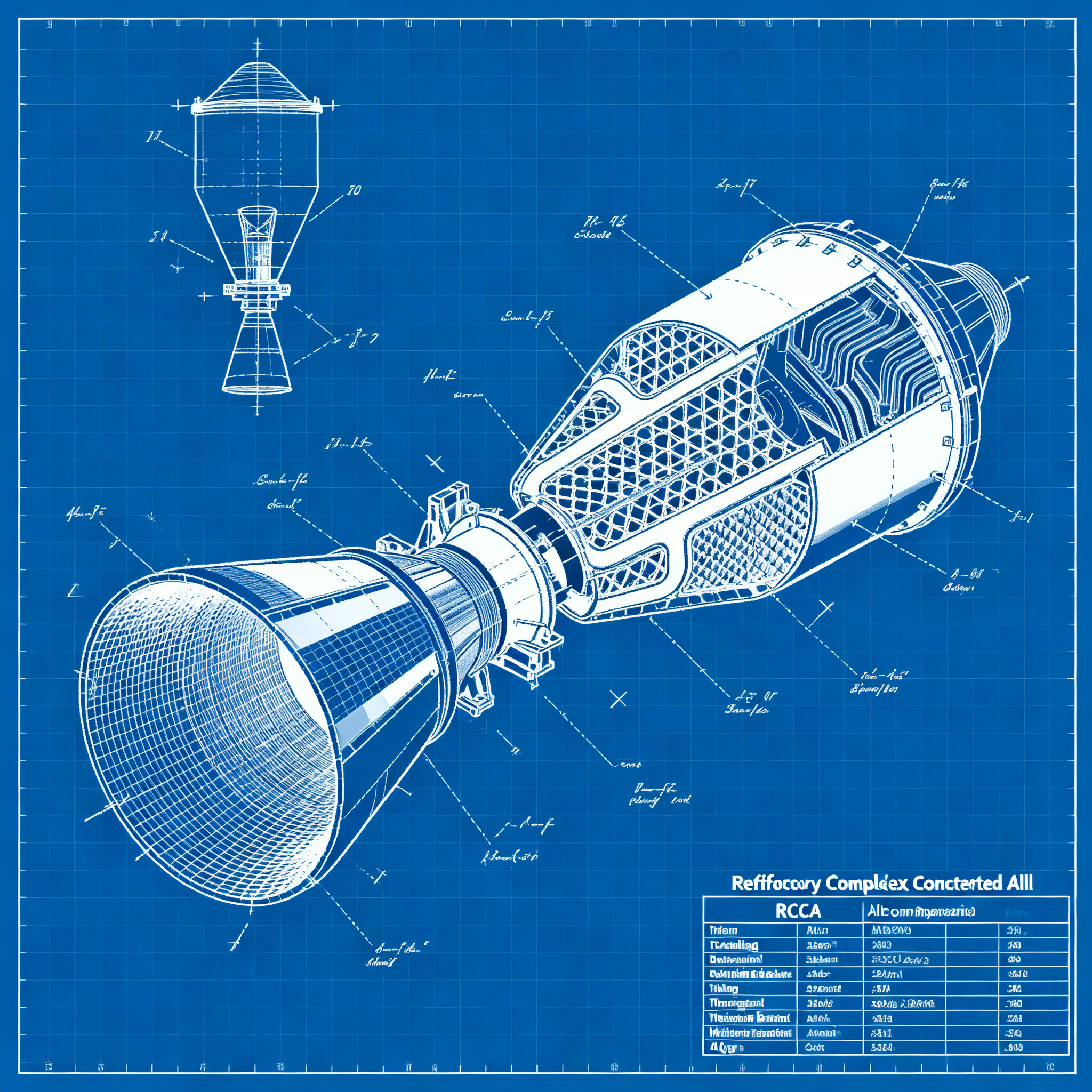
Alloy Evolution: How high-entropy refractory alloys are redefining the aerospace industry
High-entropy refractory alloys represent a revolution in materials for extreme applications, offering unprecedented properties for combustion chambers, rocket nozzles, and hypersonic components. Unlike traditional alloys such as Inconel 625 and 718 – developed in the 1960s and still dominant – these new families of materials combine elements in high proportions to create disordered structures with superior performance at temperatures above 1000°C.
Definition and classification of high-entropy alloys
High-entropy alloys are distinguished into different categories with specific characteristics and applications, from the crystal structure to the proportions of the constituent elements.
The Refractory Complex Concentrated Alloys (RCCA), such as the Tanbium developed for combustion chambers and rocket nozzles, represent an innovative approach that combines refractory elements such as hafnium, ruthenium, titanium, and tungsten in relatively high proportions. These alloys differ from traditional ones in which a primary material is modified with small additions of other elements.
The High Entropy Alloys (HEA) constitute a broader category characterized by a disordered structure, with large proportions of individual elements that generate unique structural properties. There are then the Refractory High-Entropy Alloys (RHEAs), which include elements such as niobium, tantalum, and tungsten, specifically designed for high-temperature applications.
Non-refractory HEAs contain mainly chromium, cobalt, iron, and nickel, such as AlCoCrFeNi for marine applications and CrCoFeNi (Cantor alloy) used in turbine blades. The Medium Entropy Alloys (MEA), such as VCoNi, represent a distinct category with fewer than five elements. This complex classification resembles a taxonomic system in which some materials can exhibit multiple characteristics simultaneously.
Microstructure and physical properties: FCC vs BCC
The fundamental crystal structure – face-centered cubic or body-centered cubic – directly determines the thermomechanical performance of alloys under extreme operating conditions.
The distinction between structures Face-Centered Cubic (FCC) e Body-Centered Cubic (BCC) is crucial for understanding industrial applications. FCC structures, shared with materials such as aluminum, platinum, and gold, characterize alloys like CrCoFeNi developed at Oak Ridge, which can also form BCC structures under certain conditions.
BCC alloys, such as the wear-resistant FeCoCrAlCu, offer specific properties for high-stress applications. RCCA typically exhibit a disordered BCC structure with complex microstructure, resulting in much greater resistance to corrosion and oxygen degradation, with melting points above 1000°C.
These alloys demonstrate excellent yield strength, better resistance to viscous flow, fracture toughness, and fatigue properties, while being potentially lighter and more ductile than existing materials. Microstructure directly influences the material's ability to maintain structural integrity in extreme environments such as hypersonic engines and nuclear reactors.
Aerospace applications: RCCA and extreme components
Refractory alloys surpass traditional technological limits in critical applications where extreme temperatures and mechanical stresses require uncompromised performance.
Tanbium, developed by Metalysis, Skyora, and Thermo-Calc Solutions, was specifically created for combustion chambers and rocket nozzles, applications where traditional alloys reach their operational limits. Hypersonics represents the new frontier of technological competition, requiring materials capable of withstanding vehicles traveling at twenty times the speed of sound.
RCCA are considered fundamental for missiles, advanced engines, and space applications. The research does not aim to find a single ideal material to replace niobium C103 or Inconel, but to create pathways to develop custom-designed alloys that perform optimally in specific areas: aircraft coatings, turboprops, turbines, combustion chambers, nose cones.
Parallelly, new nickel-based superalloys such as ABD-1000AM, developed by Alloyed with ITP Aero and Cranfield University, are specifically designed for the additive production of jet engine components operating above 1000°C. This alloy represents an evolution compared to the nickel-based superalloys of the 1930s, which remain dominant despite aerospace technological advancement.
Advanced production processes: melting, molding, and heat treatments
Modern additive production methodologies allow for the production of stable alloys, overcoming the limitations of traditional consumable electrode remelting processes.
RCCA production has historically been problematic, with evident crack phenomena. Researchers have experimented with technologies such as cold spray and practically every available method. The difficulty arises from the combination of elements with very different properties that require different temperatures, with the possibility of performing the alloy before additive production or during the 3D printing process itself.
The techniques of additive manufacturing (AM) offer significant advantages in reducing the chemical segregation of heavy elements. Traditional processes such as ESR (Electroslag Remelting) and VAR (Vacuum Arc Remelting) create large and deep single melting pools – up to 508 mm of surface and 193 mm of depth in VAR – which allow the segregation of heavy elements such as molybdenum.
The melting pools associated with AM methods have a width of less than 0.5 mm and a depth of less than 0.18 mm – up to 1000 times smaller than VAR and ESR processes – resulting in faster solidification rates and less segregation. Processes such as laser powder bed fusion (PBF-LB) and electron beam powder bed fusion (PBF-EB) allow for precise control of the melting pool depth, which is essential for high-molybdenum-content alloys such as Haynes 242.
Several simultaneous developments make RCCAs particularly suitable: new competition between major powers is fueling concerns about supply chains, stimulating research into alternative materials obtainable from locally available raw materials. This convergence of geopolitical and technological factors is accelerating innovation in refractory alloys.
Conclusion
High-entropy alloys represent a decisive technological breakthrough for aerospace, but their effectiveness depends on targeted design choices that consider crystal structure, elemental composition, and production processes. The distinction between HEA, RHEA, MEA, and RCCA is not merely academic: it determines suitability for specific applications in extreme environments. While traditional nickel-based superalloys continue to dominate many applications after decades, new families of refractory alloys promise superior performance for the next generation of hypersonic vehicles, aerospace engines, and defense systems.
Deepen the technical specifications of RHEA alloys to identify innovative solutions for your engineering projects and evaluate how additive manufacturing processes can overcome the limitations of traditional methods in the fabrication of critical high-temperature components.
article written with the help of artificial intelligence systems
Q&A
- What are the main characteristics of high-entropy refractory alloys compared to traditional alloys?
- High-entropy refractory alloys combine elements in high proportions, creating disordered structures with superior performance at temperatures above 1000°C. Unlike traditional alloys such as Inconel, developed in the 1960s, these new materials offer greater corrosion resistance, better mechanical properties, and very high melting points.
- How do Refractory Complex Concentrated Alloys (RCCA) differ from other high-entropy alloys?
- RCCA differ because they combine refractory elements such as hafnium, ruthenium, titanium, and tungsten in high proportions, resulting in greater resistance to thermal degradation and oxidation. They are specifically designed for extreme applications such as combustion chambers and rocket nozzles, where traditional alloys cannot guarantee optimal performance.
- What is the difference between FCC and BCC crystal structures in high-entropy alloys?
- The Face-Centered Cubic (FCC) structure is typical of metals such as gold and platinum and offers good ductility; while the Body-Centered Cubic (BCC), present in many RCCA, guarantees greater mechanical strength and stability at elevated temperatures. The choice of structure directly influences toughness, yield strength, and the ability to operate in extreme environments.
- Why are additive manufacturing techniques advantageous for the fabrication of RCCA?
- Additive manufacturing processes, such as PBF-LB and PBF-EB, allow for much smaller melt pools and rapid solidification, reducing the chemical segregation of heavy elements. This counteracts the historical problems related to traditional production via VAR or ESR, improving the quality and homogeneity of complex alloys.
- In which aerospace sectors do RHEA and RCCA alloys find application?
- RHEA and RCCA are used in critical components such as combustion chambers, rocket nozzles, and hypersonic systems, where materials capable of withstanding temperatures above 1000°C and high mechanical stresses are required. They are also being studied for advanced coatings and high-performance turbines.