
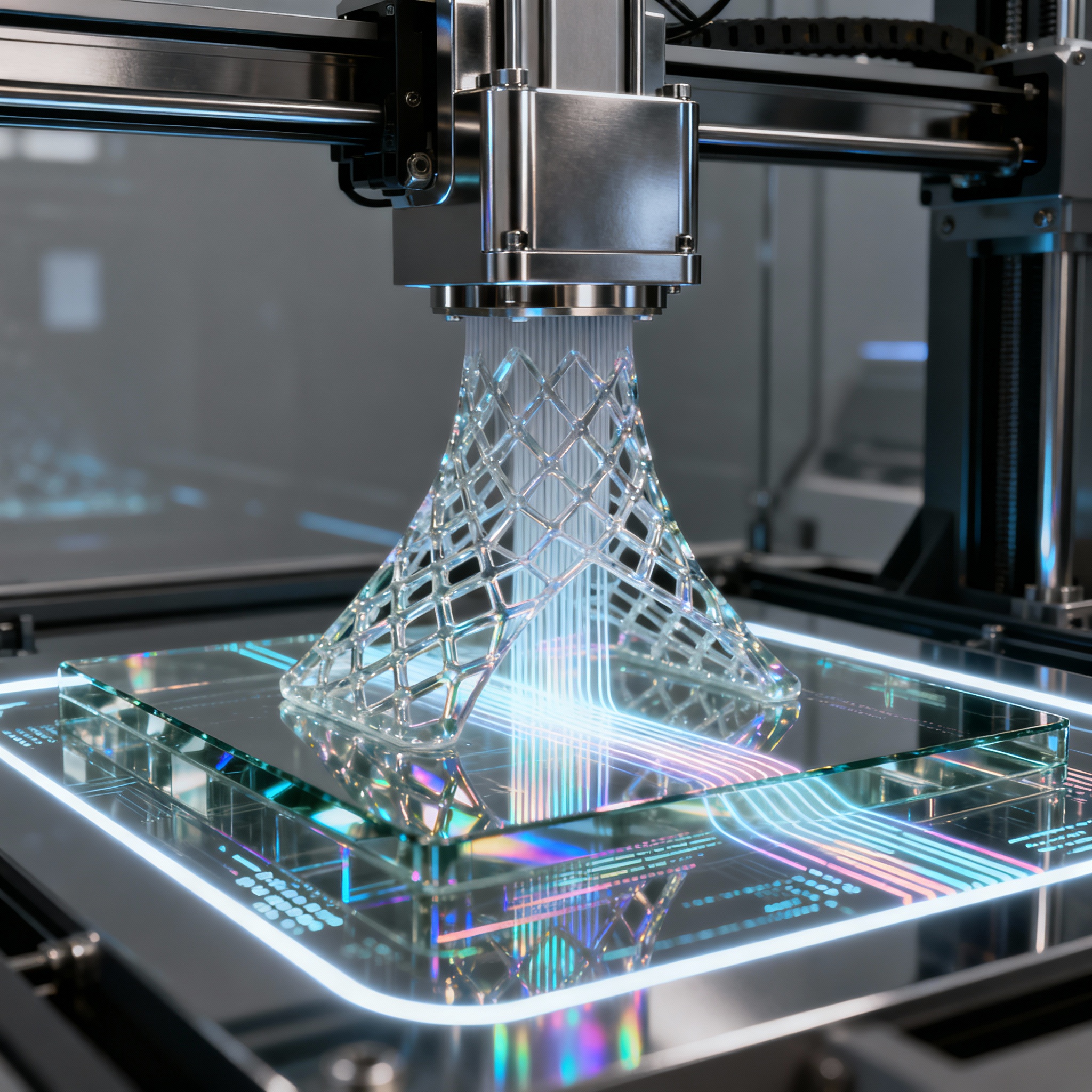
Adoption of 3D printing in industry and manufacturing: an ongoing revolution
Introduction to 3D printing technologies in the industrial sector
In 2025, 3D printing made a decisive leap towards industrial maturity, definitively surpassing the prototyping phase to establish itself in real and highly demanding applications. The global manufacturing sector is witnessing an unprecedented transformation, with additive technology consolidating as a strategic tool in critical areas such as defense, aerospace, and construction.
The growing influence of Asian manufacturers represents one of the most significant changes in the industrial landscape. Companies like Bambu Lab have conquered the maker community and successfully expanded into industrial and educational environments, even opening physical stores in China to increase brand visibility. Growth is no longer limited to the desktop market: several Asian companies have strengthened their presence in the industrial segment, beginning to compete in technologies that until recently were dominated by a small group of Western players.
An emblematic example is electron beam melting (EBM), a process long associated with Arcam, which now sees new Asian entrants like QBeam, Xi'an Sailong Metal, and JEOL. Meanwhile, established players such as Farsoon, E-Plus-3D, and BLT are strengthening their capabilities in other metal additive manufacturing technologies, expanding their solution portfolios and gaining ground in high-demand sectors.
Multi-material printing is another frontier redefining production possibilities: it allows for the creation of rigid, flexible, and specialized regions within a single build, reducing the need for fastening elements, adhesives, and manual assembly, with a consequent reduction in labor and overall production costs.
Competitive advantages and reduction of production costs
The economic benefits of 3D printing in the manufacturing industry are now evident and measurable. The technology offers significant savings in terms of both direct costs and operational efficiency, radically transforming traditional processes.
In industrial repairs, the adoption of 3D scanning has yielded extraordinary results. The Colt Group, an American company specialized in the repair of pressure pipelines, implemented the Artec Leo 3D scanner, achieving equipment digitization up to 18 times faster than previous methods. In oil and gas refineries, where every minute of downtime can cause colossal losses, the technology eliminates guesswork from repairs, drastically reduces field adjustments, and ensures greater production continuity.
Multi-material printing further contributes to cost reduction by eliminating manual assembly. By producing complete parts with different material properties in a single build, manufacturers significantly lower labor costs and accelerate production times. This translates into more realistic prototypes and end-use parts ready directly from the printer, reducing post-processing stages.
In the construction sector, the additive approach has demonstrated substantial economic benefits. United Utilities' Printfrastructure project recorded a 60% reduction in construction times for CSO chambers, a 27% carbon saving, and significant cost savings, cutting carbon emissions by up to 50% compared to traditional construction.
The technology also enables extending the useful life of existing assets by printing obsolete parts, avoiding costly complete replacements and reducing downtime. The ability to rapidly produce custom or out-of-production components represents a significant competitive advantage, particularly valuable in emergency scenarios.
Case studies: successes and challenges in implementation
The implementation of 3D printing in the industry has generated numerous success cases demonstrating the technological maturity achieved, accompanied, however, by relevant challenges requiring strategic approaches.
In the aerospace sector, 2025 saw multiple companies conduct tests and validations of rocket engines incorporating 3D-printed components into operational systems. Examples from New Frontier Aerospace, POLARIS Spaceplanes, AVIO SpA, and Agnikul Cosmos demonstrate that additive manufacturing is now fully integrated into aerospace programs. Such progress is made possible by the continuous evolution of metal additive manufacturing solutions, capable of producing parts that withstand high temperatures and extreme mechanical stresses.
The vision of 3D printing in the absence of gravity remains alive: after the first metal 3D printing operation conducted in space by the European Space Agency at the end of 2024, additional tests were performed throughout 2025 to determine which materials and processes work effectively in microgravity conditions.
In the construction sector, Caracol, an Italian company specializing in large-scale robotic additive manufacturing, raised 40 million dollars in 2025 to accelerate international expansion in the United States, the European Union, and the Middle East. The sector recorded a strong push towards more sustainable materials, including recycled mixes and formulations with lower environmental impact.
However, adoption is not without obstacles. In the food sector, after the enthusiasm of 2024, 3D food printing appears to have slowed in 2025. Although development has not stopped entirely, with ongoing research projects focused on nutrition for people with dysphagia, the application is no longer progressing at the pace of previous years.
Impact on the supply chain and logistics
3D printing is profoundly revolutionizing traditional supply chains and established logistics models, introducing unprecedented paradigms of decentralized and on-demand production.
The technology enables the localized production of components, drastically reducing dependence on complex and vulnerable global supply chains. This capability has proven particularly strategic in unstable geopolitical contexts and scenarios requiring rapid response.
In the hydrogen sector, the Catalan Institute for Energy Research (IREC) has launched Merce Lab, the world's first pilot plant using ceramic 3D printing to produce hydrogen technologies. The project aims to produce solid oxide cells (SOC) on a pre-industrial scale using advanced 3D printing processes and high-tech industrial assembly techniques. This localized production of critical energy components represents a model for democratizing access to clean and sustainable energy, reducing dependence on distant suppliers.
Additive manufacturing also enables complex geometries that offer superior performance compared to polymer-based solutions, increasing energy density and making these devices particularly attractive for maritime transport, aviation, and large-scale renewable energy storage.
The reduction in material usage and the ability to create lightweight, compact designs represent significant advantages for the industry, translating into more efficient devices, potentially lower costs (estimated around €800/kW), and a more sustainable production process, avoiding materials such as cobalt or nickel.
Multi-material technology finds application in a wide range of sectors, from footwear to robotics, from medical devices to consumer products. The ability to integrate multiple materials into a single component opens up new design possibilities previously impractical or impossible, allowing companies to create parts that combine structural strength, flexibility, electronic integration, and aesthetic appeal in a single build.
Future perspectives and emerging technological developments
The future of industrial 3D printing looks rich with innovations and increasingly sophisticated applications.
article written with the help of artificial intelligence systems
Q&A
- In which sectors has 3D printing established itself as a strategic tool in 2025?
- In 2025, 3D printing has become strategic in defense, aerospace, and construction, moving beyond the prototyping phase to enter real and high-demand production.
- How is the landscape of industrial 3D printing manufacturers changing?
- Asian manufacturers like Bambu Lab, QBeam, Farsoon and BLT are gaining industrial market share, competing with traditional Western players even in advanced technologies like electron beam melting.
- What economic benefits does 3D printing offer in industrial repairs?
- The Colt Group achieved 18 times faster digitization with 3D scanners, eliminating guesswork and reducing field adjustments in refineries, where every minute of downtime costs millions.
- How does multi-material printing reduce production costs?
- It produces complete components with rigid, flexible, and specialized regions in a single build, eliminating manual assembly, adhesives, and fastening elements, slashing labor and time.
- What challenges is 3D printing encountering in the food sector in 2025?
- After the enthusiasm of 2024, food 3D printing has slowed; only research projects on nutrition for dysphagia continue, but commercial application is no longer advancing at the previous pace.
- How is 3D printing transforming the hydrogen supply chain?
- IREC launched Merce Lab, the world's first pilot facility using ceramic 3D printing to produce solid oxide cells locally, reducing dependence on distant suppliers and lowering costs to ~800 €/kW.


