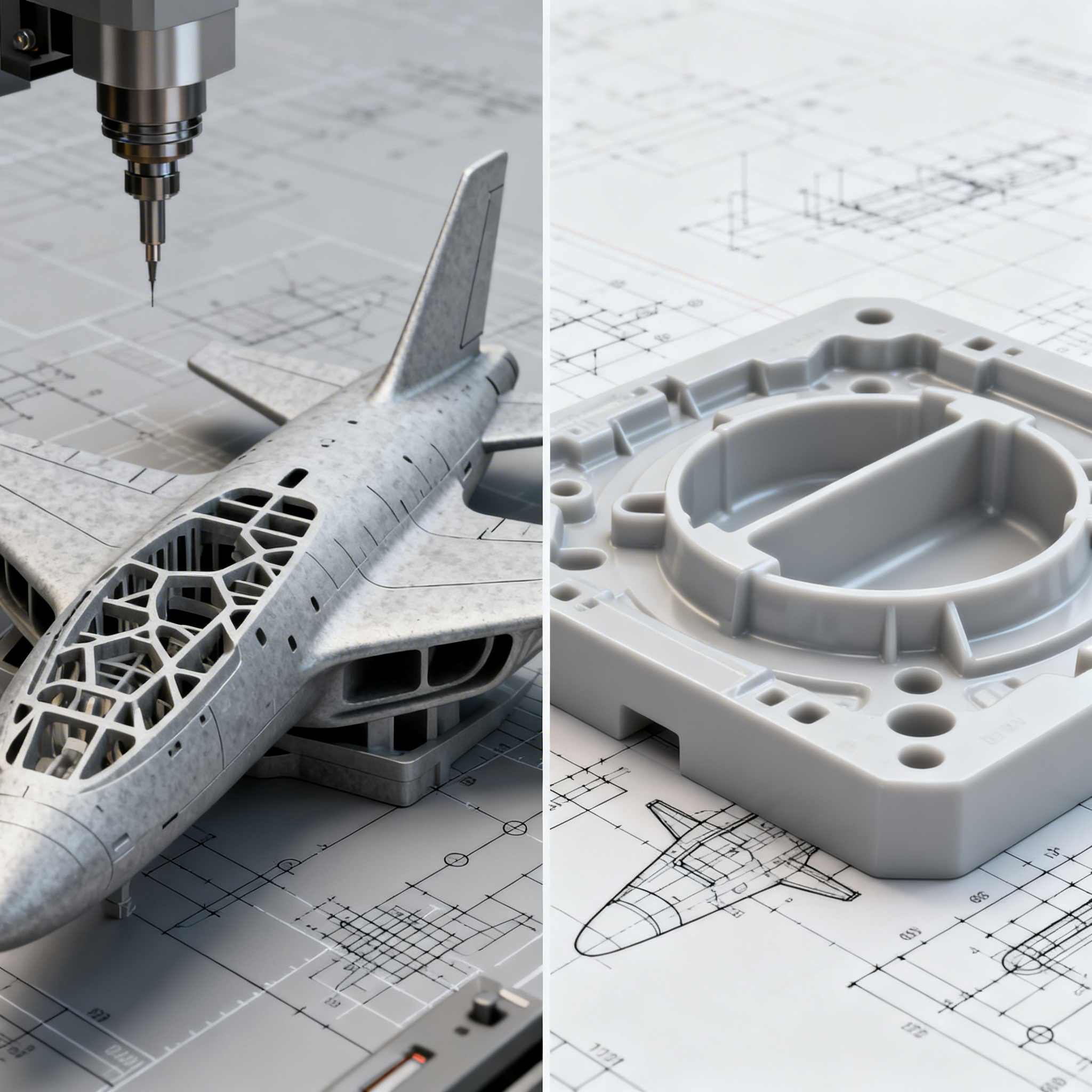
Additive Manufacturing vs Plastic Injection: Trade-offs in Industrial and Aerospace Contexts
In the industrial sector, the choice between 3D printing and traditional technologies like plastic injection depends increasingly on a precise evaluation of economic and productive trade-offs.
The decision between additive manufacturing and plastic injection is no longer a matter of technological preference, but a strategic choice that directly impacts corporate competitiveness. While plastic injection continues to dominate standardized high-volume production, 3D printing is establishing itself as the preferred solution for low-run and high-personalization applications, especially in the aerospace and advanced industrial sectors. The key lies in understanding when the setup costs of injection exceed the benefits of its scale efficiency, and when, instead, the flexibility of additive manufacturing justifies its production limits.
Economic Efficiency: 3D Printing vs Plastic Injection
The analysis of production costs reveals that the economic convenience between the two technologies depends critically on production volume and initial setup costs.
According to a recent study published in the International Journal of Precision Engineering and Manufacturing-Green Technology, plastic injection maintains clear advantages in standardized high-volume production due to its intrinsic efficiency. However, additive manufacturing demonstrates superiority in high-mix and low-volume scenarios, where setup costs dominate the economic equation.
The economic break-even point typically occurs when the costs of injection molds – which can reach tens of thousands of euros – are not amortized over sufficiently high volumes. 3D printing completely eliminates these initial costs, making the production of single customized pieces economically sustainable.
Deutsche Bahn and General Electric have adopted additive manufacturing precisely for the on-demand production of spare parts and maintenance applications, where the need for warehousing and machine downtime make plastic injection economically unsustainable despite its lower unit cost at high volumes.
Design Flexibility and Personalization
3D printing offers geometric freedom and structural optimization capabilities impossible to replicate with plastic injection, which are particularly critical in aerospace applications.
In the aerospace sector, the ability to consolidate multiple components into a single printed part represents a decisive competitive advantage. A prime example is that of a helicopter intake duct developed by an aerospace OEM: 3D printing has enabled the consolidation of the geometry, optimization of airflow, and a reduction in costs by 80% compared to the traditional multi-component approach.
VOCUS GmbH, an aerospace supplier, developed a sliding exhaust component for aircraft using EOS technology and Materialise workflow, achieving a 10-fold increase in service life. The critical part of the success was the possibility to optimize the internal geometry for thermal management, which is impossible to achieve with plastic injection or traditional machining.
Plastic injection, constrained by the need to extract the part from the mold, drastically limits geometric possibilities: complex undercuts, branched internal channels, and lattice structures remain the exclusive domain of additive manufacturing.
Scalability and Production Volume
When production exceeds certain volumetric thresholds, the efficiency of plastic injection becomes unbeatable, while additive manufacturing excels in small batches and mass customization.
Plastic injection can produce thousands of identical parts per day with unit costs that decrease drastically as volume increases. Once the mold is amortized, the marginal cost per part becomes minimal, making the technology ideal for standardized production runs exceeding several thousand units.
Conversely, additive manufacturing maintains relatively constant unit costs regardless of volume, since each part requires the same build time. This characteristic, seemingly disadvantageous, becomes a strength when it is necessary to produce hundreds of different variants or limited quantities.
The study highlights how continuous optimization of workflows, expansion of build areas, faster polymerization methods such as Continuous Liquid Interface Production, and integrated automation systems are central to improving the industrial throughput of additive manufacturing. However, even with these improvements, 3D printing will hardly compete with plastic injection in high-volume standardized production.
Case Studies: Applications in the Industrial and Aerospace Sectors
The operational integration of the two technologies in real-world contexts demonstrates that the choice depends on specific application needs rather than on absolute technological superiority.
Deutsche Bahn, the German national railway operator, has implemented on-demand spare parts production via additive manufacturing to reduce downtime and eliminate expensive warehouses of low-turnover components. In this context, plastic injection would require investments in molds for parts that might only be needed sporadically.
General Electric uses 3D printing for tooling and maintenance applications, where customization and rapid delivery times outweigh any unit cost advantage of plastic injection. The company integrates both technologies into its supply chain, selecting the appropriate one based on the specific use case.
In the aerospace sector, VOCUS obtained EASA approval for a 3D-printed exhaust component after 20 hours of ground testing and 35 hours of flight tests, demonstrating that additive manufacturing can meet the most stringent certification requirements when the process is adequately qualified and traced.
Materials and Mechanical Performance
The mechanical properties and environmental resistance of materials represent critical factors in the technological choice, with significant differences between the processes.
Plastic injection offers consolidated materials with well-documented and predictable mechanical properties. Injection thermopolymers benefit from decades of development and characterization, with comprehensive performance databases in various operating conditions.
3D printing materials, although rapidly evolving, often exhibit anisotropy due to the layer-by-layer construction, requiring attention in the orientation of parts relative to expected loads. However, advanced materials such as Inconel 718 for metal additive applications or high-performance polymers are bridging the performance gap.
In the aerospace case, components printed in metal alloys have demonstrated resistance to extreme thermal cycles and severe operating environments, in some cases outperforming traditional components thanks to microstructural optimization made possible by precise control of process parameters.
Conclusion
The choice between 3D printing and plastic injection requires an evaluation targeted to the specific needs of volume, customization, and operating context.
There is no universally superior technology: plastic injection dominates in standardized high-volume production, while additive manufacturing excels in customization, low volumes, and complex geometries. The most competitive companies integrate both technologies, selecting the appropriate one based on specific economic, technical, and logistical criteria.
Deepen the most suitable technologies for your production process with an analysis of technical requirements and economic constraints. Carefully evaluate expected volumes, the degree of personalization required, performance requirements and delivery times to identify the optimal solution for each specific application.
article written with the help of artificial intelligence systems
Q&A
- What are the main economic advantages of 3D printing compared to plastic injection?
- 3D printing eliminates initial setup costs like molds, making it economically sustainable for single-piece or small-batch production. It is particularly advantageous when injection mold costs are not amortized over sufficiently high volumes.
- In which sectors is 3D printing preferred over plastic injection?
- 3D printing is preferred in the aerospace and advanced industrial sectors, where high customization, complex geometries and low-volume production are required. For example, it is used for the realization of components with optimized internal structures impossible to obtain with plastic injection.
- When is plastic injection more convenient than additive manufacturing?
- Plastic injection is more convenient when producing large volumes of standardized parts. Once the mold is amortized, the marginal cost per part becomes minimal, making this technology ideal for production exceeding several thousand units.
- How do complex geometries influence the choice between 3D printing and plastic injection?
- 3D printing allows the realization of complex geometries, such as branched internal channels and lattice structures, impossible to produce with plastic injection. This is crucial in the aerospace sector, where the shape of components directly influences performance.
- What are the main differences in terms of materials and mechanical properties between the two technologies?
- Plastic injection molding uses established materials with predictable mechanical properties, while 3D printing can exhibit anisotropy due to the layer-by-layer construction. However, advanced materials for 3D printing are closing the performance gap, especially in the metal sector.