Additive Manufacturing for Hypersonic Vehicles: How 3D Printing is Changing the Aerospace Game
The race towards low-cost hypersonic testing is redefining the rules of aerospace engineering thanks to 3D printing. A recent industry study predicts that by 2034, rocket engines will be the main source of value for manufacturers of components made with additive technologies. To reach this goal, the testing phase for hypersonic engines and vehicles must become much more frequent and accessible, overcoming the limits imposed by the scarcity of wind tunnels and traditional infrastructures.
The Defense Innovation Unit (DIU) of the Pentagon has launched the HyCAT program – Hypersonic and High-Cadence Airborne Testing Capabilities – precisely to develop hypersonic testing platforms that are more economical, faster to produce, and easier to reuse. The first test of the program used the DART AE demonstrator from the Australian startup Hypersonix, launched with Rocket Lab's HASTE rocket: this is the world's first hypersonic platform with a fully 3D-printed airframe, three meters long and designed to operate above Mach 5.
The New Aerospace Frontier: Hypersonic Vehicles and Additive Manufacturing
Hypersonic vehicles represent a crucial frontier for modern defense and space exploration; the adoption of additive manufacturing accelerates their development and reduces costs.
With approximately 70 different hypersonic programs currently funded by the Pentagon, access to low-cost testbeds could have a significant impact on the overall timeline of the department's research and development objectives. The HyCAT program was conceived to alleviate the bottleneck represented by wind tunnels, focusing on test vehicles that can be produced and launched with much tighter cycles.
The declared goal is to provide the US hypersonic community with flight platforms usable to validate not only scramjet engines and high-temperature materials, but the entire hypersonic value chain: avionics, guidance systems, control surfaces, thermal protection systems, and integration interfaces. As stated by Lt. Col. Nicholas Estep, director of the DIU's Emerging Technologies portfolio, “accessing the commercial and non-traditional ecosystem is a key factor for accelerating progress in the hypersonic community, especially for closing mission timelines and pushing towards mass and affordability.”
Advanced Materials for Extreme Environments
The development of heat-resistant alloys and ceramics is essential for building reliable and high-performance hypersonic components.
Hypersonic vehicles operate in extreme conditions, with surface temperatures exceeding 1000°C and exceptional structural loads. Complex composition refractory ceramic alloys (RCCA) represent a new class of materials that combine elements such as hafnium, ruthenium, titanium, and tungsten in optimized proportions to achieve melting points above 1000°C, excellent resistance to oxygen corrosion, and superior mechanical properties in terms of viscous creep resistance, fracture toughness, and fatigue.
These advanced materials are particularly suitable for hypersonic components such as scramjet engines, control surfaces, and structures exposed to intense heat fluxes. Additive manufacturing allows for the processing of these complex alloys, overcoming the difficulties of traditional metallurgy and enabling the creation of optimized geometries for thermal and structural management within a single integrated component.
Innovative Production Processes: From Design to Realization
3D printing enables geometries impossible with traditional methods, opening new design possibilities for scramjet engines and integrated structures.
The Hypersonix DART AE demonstrator perfectly illustrates the potential of additive manufacturing for hypersonic vehicles. The aircraft fuselage, approximately 3 meters long and with a mass around 300 kg, was entirely manufactured in high-temperature alloys via additive manufacturing. Printing the entire platform allows for the optimization of weight, rigidity, and thermal resistance, drastically reducing the time between prototypes, a crucial aspect for high-cadence test campaigns.
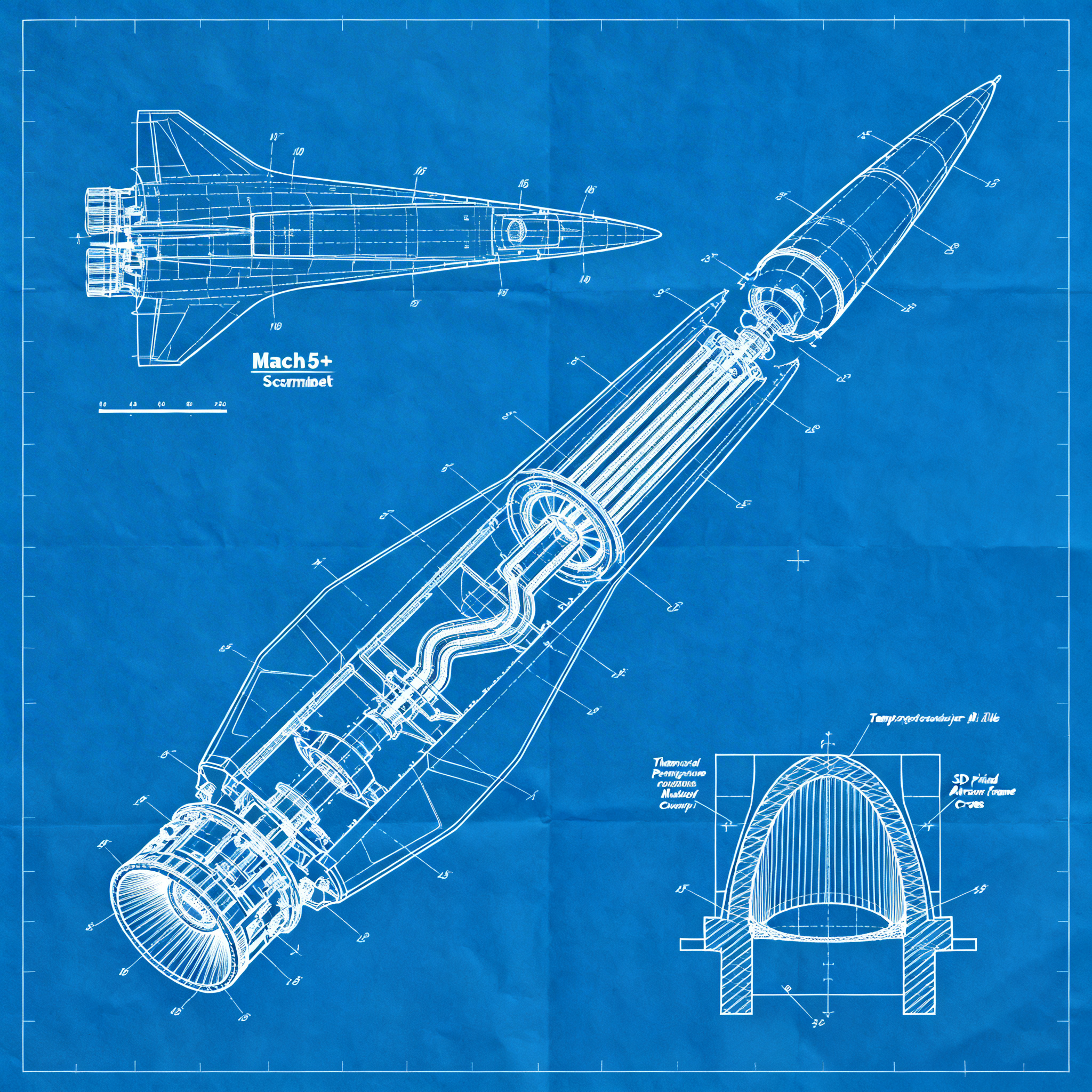
The SPARTAN engine equipping the DART AE is a fifth-generation scramjet entirely 3D printed, characterized by fixed geometry, absence of moving parts, and the use of hydrogen as fuel. Additive manufacturing allows for the creation of the complex internal geometry required for supersonic combustion in a single piece, integrating cooling channels and aerodynamic surfaces that would be impossible to achieve with conventional techniques.
Ursa Major followed a similar path with its Hadley H13 engine, built for approximately 80% using additive manufacturing. After passing the initial hot-fire tests, the H13 incorporates advanced materials to extend service life and increase performance, while the internal production of key components via 3D printing allows for tighter control over quality and costs.
HyCAT and Beyond: Reconfigurable Test Platforms
The HyCAT program demonstrates how AM can make hypersonic testing faster, cheaper, and more replicable than classic techniques.
The combination of a qualified commercial launcher like Rocket Lab's HASTE and a hypersonic test vehicle entirely produced with digital processes allows for the experimentation of a more industrial testing model, based on frequent iterative cycles rather than isolated high-value campaigns. During the “That's Not A Knife” mission, HASTE brought DART AE to the high-altitude release point, creating the conditions for the ignition of the scramjet engine and flight in the hypersonic regime beyond Mach 5.
HyCAT shifts the focus: instead of limiting itself to the engine, the program aims to industrialize the production of test vehicles itself, transforming them into relatively reusable assets that can be produced in short times, thus generating a greater number of test cases for engines, materials, and subsystems. If the HyCAT methodology proves effective, it could generate a structural increase in demand for 3D-printed components for test vehicles, aerodynamic structures, cooling systems, and thermal protection elements.
Case Study: Hypersonix and Ursa Major
Two industrial examples illustrating the practical application of AM in the development of operational hypersonic propulsors and vehicles.
Hypersonix presents DART AE as a demonstrator of sovereign hypersonic capabilities, emphasizing the role of design and production carried out in Australia. On an application level, the company aims to offer government and industrial clients a high-frequency testing service, where payloads, materials, sensors, or guidance algorithms can be tested in a real hypersonic environment with relatively rapid mission cycles.
Ursa Major, for its part, developed the Hadley engine as a standardized, ready-to-use solution for hypersonic flight and small launchers. As explained by Chris Spagnoletti, CEO of Ursa Major, “Hadley is the fundamental engine of Ursa Major that has already flown hypersonic several times. With new materials and production processes, the H13 can be reused more than twice as many times as previous variants, reducing cost per flight and supporting new test objectives and mission profiles.”
The Hadley engine became the first American engine in its class to exceed Mach 5 and return intact, a result achieved aboard Stratolaunch's Talon-A. For defense clients, the strategic pressure behind the H13 is clear: hypersonic programs are moving faster than traditional manufacturing can support. Additive manufacturing allows for the production of complex components without dedicated equipment, iterating them rapidly, and scaling production without having to reorganize entire supply chains.
Conclusion
Additive manufacturing is not just an emerging technology, but a key operational tool for innovation in hypersonic systems.
The DART AE case highlights how additive manufacturing is becoming a key element in the development of hypersonic systems, both on the propulsion and structural fronts.
article written with the help of artificial intelligence systems
Q&A
- What is the main objective of the HyCAT program launched by the Pentagon?
- The HyCAT program aims to develop hypersonic test platforms that are cheaper, faster to produce, and easily reusable. It wants to overcome the limitations of traditional infrastructures such as wind tunnels, allowing for more frequent and accessible testing to accelerate the development of hypersonic vehicles.
- How is 3D printing used in the development of the Hypersonix DART AE demonstrator?
- The DART AE cell is entirely 3D printed using high-temperature alloys, allowing for the optimization of weight, rigidity, and thermal resistance. Furthermore, the SPARTAN scramjet engine was built as a single piece, integrating complex geometries impossible to achieve with traditional methods.
- What advantages does additive manufacturing offer in the development of scramjet engines?
- 3D printing allows for the creation of complex geometries necessary for supersonic combustion in a single component, including cooling channels and aerodynamic surfaces. It reduces production times, improves structural integration, and lowers costs compared to traditional methods.
- What materials are used to withstand the extreme conditions of hypersonic vehicles?
- Complex composition refractory ceramic alloys (RCCAs) are used, which include elements such as hafnium, ruthenium, titanium, and tungsten. These materials offer high melting points, corrosion resistance, and good mechanical properties under thermal and structural stress.
- How does the Ursa Major Hadley H13 engine leverage additive manufacturing?
- The H13 is built approximately 80% using additive technologies, allowing for greater control over quality and costs. Thanks to new materials, it can be reused multiple times compared to previous versions, reducing cost per flight and increasing test frequency.