
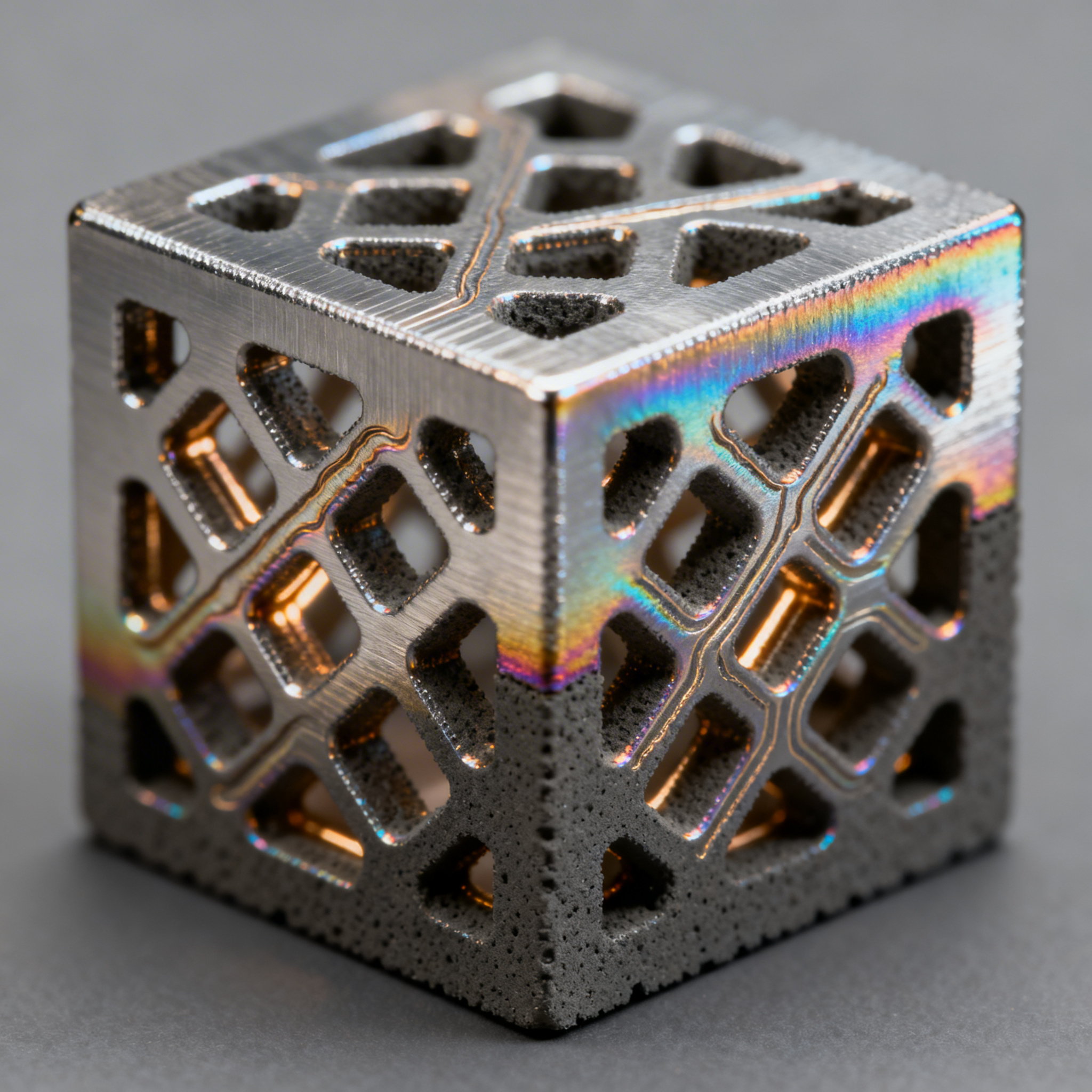
Metal and Ceramic Additive Manufacturing: Innovations Transforming Industrial Production
In 2025, innovations in additive manufacturing of metals and ceramics have shifted the focus from mere technological innovation to concrete industrial implementation, opening up production scenarios previously unimaginable. Recent developments in 3D printing are reshaping production capabilities with advanced applications, from the realization of large metal structures to the fabrication of end-use ceramic components for high-tech sectors.
InertOn and the Change in DED for Metals
The new InertOn DED head guarantees precise atmospheric control without closed chambers, increasing process efficiency and quality.
LabAM24 presented InertOn, a wire direct energy deposition head that integrates a gas shielding around the melt pool, creating an adaptive inert environment in real-time. The chamber-less DED module lowers oxygen around the pool to less than 20 ppm in about one minute, significantly faster than filling a traditional chamber with argon.
The innovation enables large-scale wire DED printing, preventing oxidation, cracks, deformations, and discoloration. The absence of closed chambers eliminates dimensional constraints, making the process flexible and scalable for large-sized components.
Scalable LFAM for Large Metal Structures
The evolution of LFAM systems enables the direct production of large-sized metal components, opening new frontiers in the naval and architectural sectors.
Large-scale additive production systems not constrained by closed structures are demonstrating concrete applications. At Formnext 2025, examples of boats, marine molds, furniture, architectural panels, and autoclave equipment made directly via 3D printing were exhibited.
The transformation mainly concerns the naval and architectural sectors, where the direct production of large-sized components eliminates complex assemblies and reduces times. The flexibility of LFAM systems represents a competitive advantage for customized and large-sized parts.
3D Ceramics towards Industry 4.0: Examples of Real Adoption
Leading companies demonstrate that ceramic 3D printing is an integral part of the production chain in high-tech and medtech.
2025 marked the turning point for ceramic 3D printing, with clear signs of commercialization. At Formnext 2025, Steinbach AG, Bosch Advanced Ceramics and Schunk Technical Ceramics occupied dedicated pavilions, confirming the maturity of the sector.
Lithoz, developer of Lithography-based Ceramic Manufacturing technology, highlighted end-use components: custom acoustic devices, dental implants and rings for gas in semiconductor processing. Volumes range from single pieces to 2,000 units per month, such as the gas injector for semiconductor etching produced by Bosch Advanced Ceramics.
Among materials, silicon carbide stands out, offering high thermal stability, hardness and resistance to chemicals, corrosion and wear. D3-AM presented a static mixer for chemical processes: jetting allowed for a more efficient geometry and the switch from metal to a more resistant ceramic. Sintering is leading to increasingly larger pieces: Schunk Technical Ceramics exhibited demonstrative components made with the IntrinSiC binder jetting process, up to 1.8 × 1.0 × 0.7 m.
The 3DCeram Sinto C1000 FLEXMATIC platform is now compatible with aluminum nitride and silicon nitride, materials used in aerospace, semiconductors and optics. Aluminum nitride combines high thermal conductivity with excellent electrical insulation; silicon nitride offers excellent wear resistance, corrosion resistance, high hardness and mechanical strength.
Conclusion
Innovations in additive manufacturing of metals and ceramics are redefining production logic. The transition from prototyping to production is gradual but the direction is clear: manufacturers seek repeatable machines, high-performance materials and workflows compliant with industrial practices.
Discover how to integrate these technologies into your processes to achieve greater flexibility, speed and sustainability. Metal and ceramic additive manufacturing is no longer a promise, but an industrial reality that is redefining the boundaries of manufacturing.
article written with the help of artificial intelligence systems
Q&A
- How does the DED InertOn head improve the metal 3D printing process without a closed chamber?
- InertOn creates a gas shield around the melt pool, lowering oxygen to <20 ppm in one minute. This prevents oxidation, cracks and deformations, allowing printing of large dimensions without dimensional constraints.
- Which sectors benefit most from LFAM systems for metals and which applications were cited?
- Naval and architecture: boats, marine molds, furniture, architectural panels, and autoclave equipment. LFAM eliminates complex assemblies and reduces lead times for large custom components.
- What ceramic materials are emerging for high-tech applications and what properties make them competitive?
- Silicon carbide (thermal stability, hardness, chemical resistance), aluminum nitride (high thermal conductivity, electrical insulation), silicon nitride (wear/corrosion resistance, hardness).
- What production volumes demonstrate the commercial maturity of 3D ceramics and a concrete example?
- From single pieces to 2,000 units/month: the gas injector for semiconductor engraving by Bosch Advanced Ceramics. This range confirms entry into the industrial production chain.
- What is the advantage of switching from metal to ceramic in the D3-AM static mixer?
- Ceramic jetting enabled a more efficient geometry and replaced metal with a material more resistant to chemicals, wear, and corrosion.


