Underwater 3D printing: new technologies for marine exploration and conservation
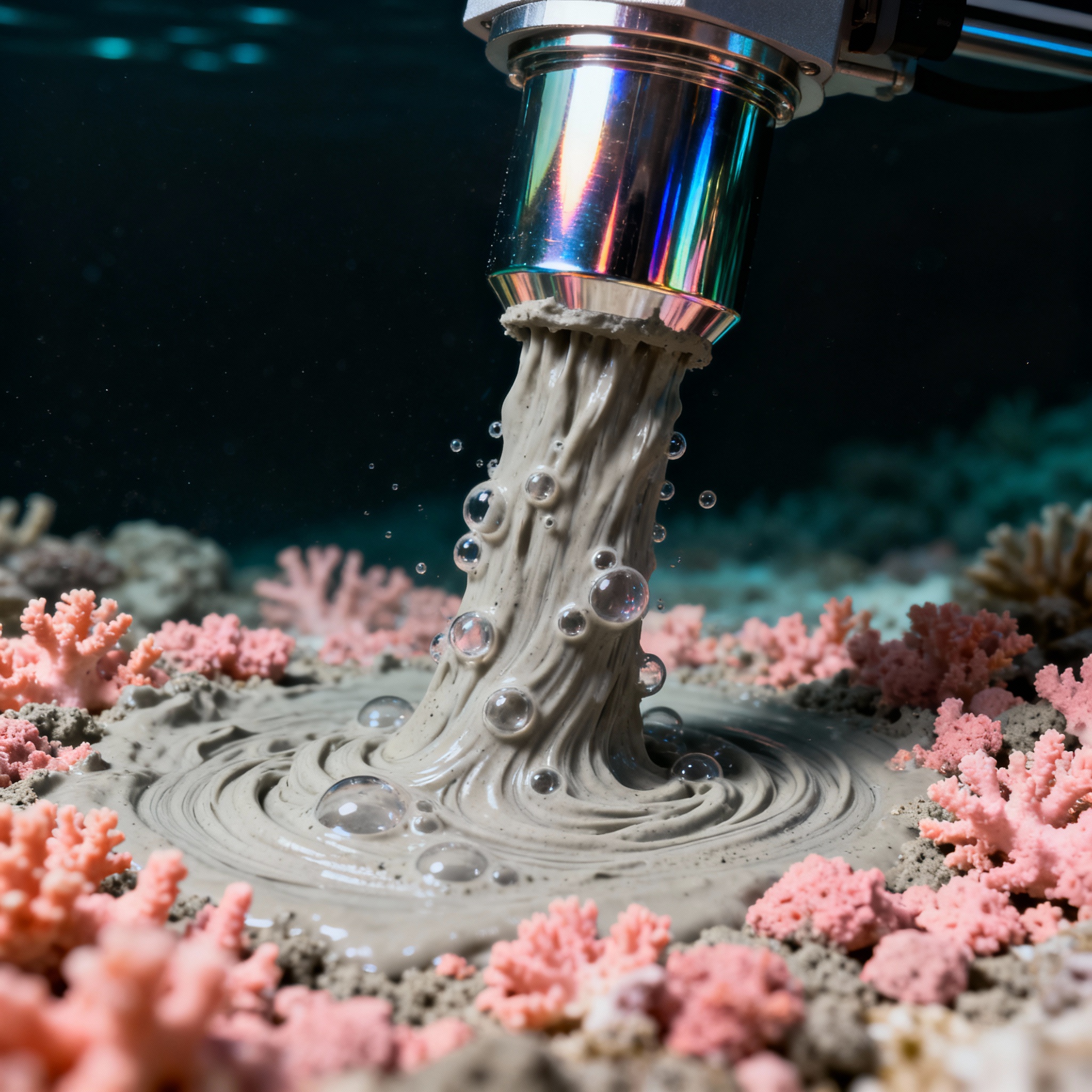
3D printing is conquering one of the planet's most hostile environments: the ocean depths. Researchers at Cornell University have demonstrated the feasibility of 3D printing concrete directly on the ocean floor, using marine sediments as the main material. This revolutionary approach, funded by the Defense Advanced Research Projects Agency (DARPA) with $1.4 million, could radically transform the construction and maintenance of maritime infrastructure.
Innovations in corrosion-resistant materials
One of the most complex challenges of underwater 3D printing concerns the development of materials capable of resisting the marine environment. The Cornell team addressed the problem of «washout,» the phenomenon whereby cement particles disperse in the water before binding, weakening the structure. As explains project leader Professor Sriramya Nair: «When anti-washout agents are added, the mixture becomes very viscous and cannot be pumped. An equilibrium between pumpability and washout resistance is needed, so that the material maintains its shape and adheres well between layers.»
The real innovation lies in the use of seafloor sediments as the main component of the concrete, with only a small amount of added cement. This solution drastically reduces the transport of materials by ship, making the process more sustainable and economical. No one had ever successfully printed structural concrete with marine sediments before this project, opening new possibilities for rethinking the very composition of concrete.
Industrial applications for offshore structures
The commercial implications of underwater 3D printing are enormous for the offshore infrastructure sector. Currently, ocean construction requires expensive and complex approaches: building on land and then transporting and sinking the structures, or creating dry areas by pumping out water, a method feasible only in shallow waters.
A system for 3D printing concrete operating in a marine environment could revolutionize the sector. The technology would offer unprecedented versatility, functioning at various depths without many of the problems of conventional approaches. Ease of transport represents a further advantage, since most of the material – the sediments – is already available on site. This could facilitate the construction of new underwater infrastructure: energy plants, tunnels, platforms, and support structures for the oil and gas industry.
The construction model proposed by Cornell promises to be quieter and less invasive. «We want to build without being disruptive,» says Nair. «If a remotely operated underwater vehicle arrives on site with minimal disturbance to the ocean, there is a way to build more intelligently, without replicating land-based practices.»
Developments in 3D printing underwater robots
Robot autonomy is crucial for the success of underwater 3D printing. Unlike land-based construction sites, where human supervisors can monitor the process, the underwater environment requires fully autonomous systems. Although sending divers is possible, their capabilities are extremely limited compared to those of a supervisor on the surface.
The Cornell team has developed advanced software control systems and specialized sensors to enable real-time monitoring and adjustment during printing. Underwater visibility can drop to almost zero once sediments are disturbed, making autonomy an absolute necessity. Traditional systems based on electromagnetic radiation, such as LIDAR, do not work underwater, forcing researchers to devise innovative solutions.
The United States Navy has already demonstrated significant progress in integrating 3D printing into naval operations, producing critical submarine components directly at sea. These developments indicate a transition from experimentation to practical implementation, with increasingly sophisticated robotic systems capable of operating autonomously in extreme conditions.
Marine environmental restoration projects
Beyond industrial applications, underwater 3D printing offers promising opportunities for marine environmental restoration. The ability to build complex structures directly on the ocean floor could facilitate conservation and ecosystem regeneration projects.
Using local sediments as printing material presents significant environmental advantages. Reducing the transport of construction materials decreases carbon emissions associated with maritime logistics. Furthermore, the precision of 3D printing allows for the creation of structures with complex geometries that encourage colonization by marine organisms, supporting biodiversity.
The Cornell team conducts frequent tests in a large water tank at the Bovay Civil Infrastructure Laboratory Complex. Although the controlled environment allows for close inspection of layer placement, strength, and geometry, such evaluation is not possible underwater in real conditions. The final DARPA project challenge, scheduled for March, will require each team to 3D print a concrete arch underwater, demonstrating the practical feasibility of the technology.
Towards a sustainable future for marine technologies
Underwater 3D printing represents a turning point for marine engineering, offering faster, cheaper, and more sustainable solutions compared to traditional methods. In-situ construction eliminates many of the logistical complexities associated with ocean infrastructure, reducing costs and environmental impact.
As the final demonstration of the DARPA project approaches, the industry is watching with interest to see if the technology can be rapidly commercialized. Success could pave the way for a new era of marine construction, where autonomous robots build critical infrastructure in the ocean depths, supporting both industrial development and environmental conservation. The ability to fabricate structures where they are needed, without prefabrication on land or deployment from the surface, could extend large-scale additive manufacturing to one of Earth's most challenging construction environments.
article written with the help of artificial intelligence systems
Q&A
- What is the main material used for the underwater 3D printing developed by Cornell University?
- The concrete is made primarily with sediments taken directly from the seafloor, to which only a small amount of cement is added. This approach reduces material transport and lowers costs.
- What technical problem did the team have to address to prevent the deterioration of the concrete in water?
- Researchers had to counteract “washout,” that is, the dispersion of cement particles before setting. They balanced the addition of anti-washout agents with the need to keep the mixture pumpable and cohesive.
- What advantages does underwater 3D printing offer over traditional offshore construction methods?
- It eliminates the transport of prefabricated structures and the creation of dry docks, reduces time and costs, allows work at various depths, and generates less noise and pollution for the marine ecosystem.
- Why is robot autonomy fundamental in this technology?
- In the depths, visibility and communications are limited, so robots must operate without human supervision, adapting the printing in real-time thanks to advanced sensors and control software.
- In addition to industrial infrastructure, how can underwater 3D printing contribute to marine conservation?
- It allows the construction of artificial substrates with complex geometries that favor the colonization of organisms, reducing emissions from material transport and supporting habitat restoration.
- What final test will the DARPA project have to pass to demonstrate the validity of the technology?
- By March, each team will have to 3D print a concrete arch completely underwater, verifying the practical feasibility and resistance of the structure made with marine sediments.