How a Custom 3D Surgical Guide Works for Tumor Localization
The Breast Cancer Locator by Cairn Surgical represents a step forward in the precision of lumpectomies thanks to a personalized 3D guide obtained from the patient's magnetic resonance imaging. This medical device, currently undergoing FDA evaluation, transforms imaging data into a physical tool that allows surgeons to locate breast tumors with millimetric precision during conservative surgeries, improving surgical margins and reducing the need for re-interventions.
Image Acquisition and 3D Modeling
The precision of the guide begins with the acquisition of the MRI in the surgical position, which is essential for reconstructing an anatomical model faithful to the intraoperative situation.
The process of creating the Breast Cancer Locator starts with the acquisition of magnetic resonance images of the patient in the supine position, the same that will be maintained during the surgical intervention. This aspect is crucial: acquiring the images in the operating position ensures that the 3D model faithfully reflects the anatomy of the breast as it will appear in the operating room, avoiding distortions due to gravity or positioning.
A radiologist analyzes the MRI slice series and traces the margins of the tumor on each section, generating a complete three-dimensional volume of the lesion. This digital segmentation process creates a precise map not only of the tumor, but also of the surrounding anatomical references such as the nipple, the inframammary fold, and other registration points that will serve for the alignment of the device.
Custom Guide Design
The design of the guide takes into account individual anatomical characteristics and the three-dimensional position of the tumor to maximize intraoperative accuracy.
Once segmentation is complete, the digital model is used to design a plastic shell that reproduces the shape of the breast like a personalized “shell”. The guide is designed to adhere perfectly to the surface of the breast thanks to the anatomical references identified during the imaging phase, ensuring a unique and repeatable positioning.
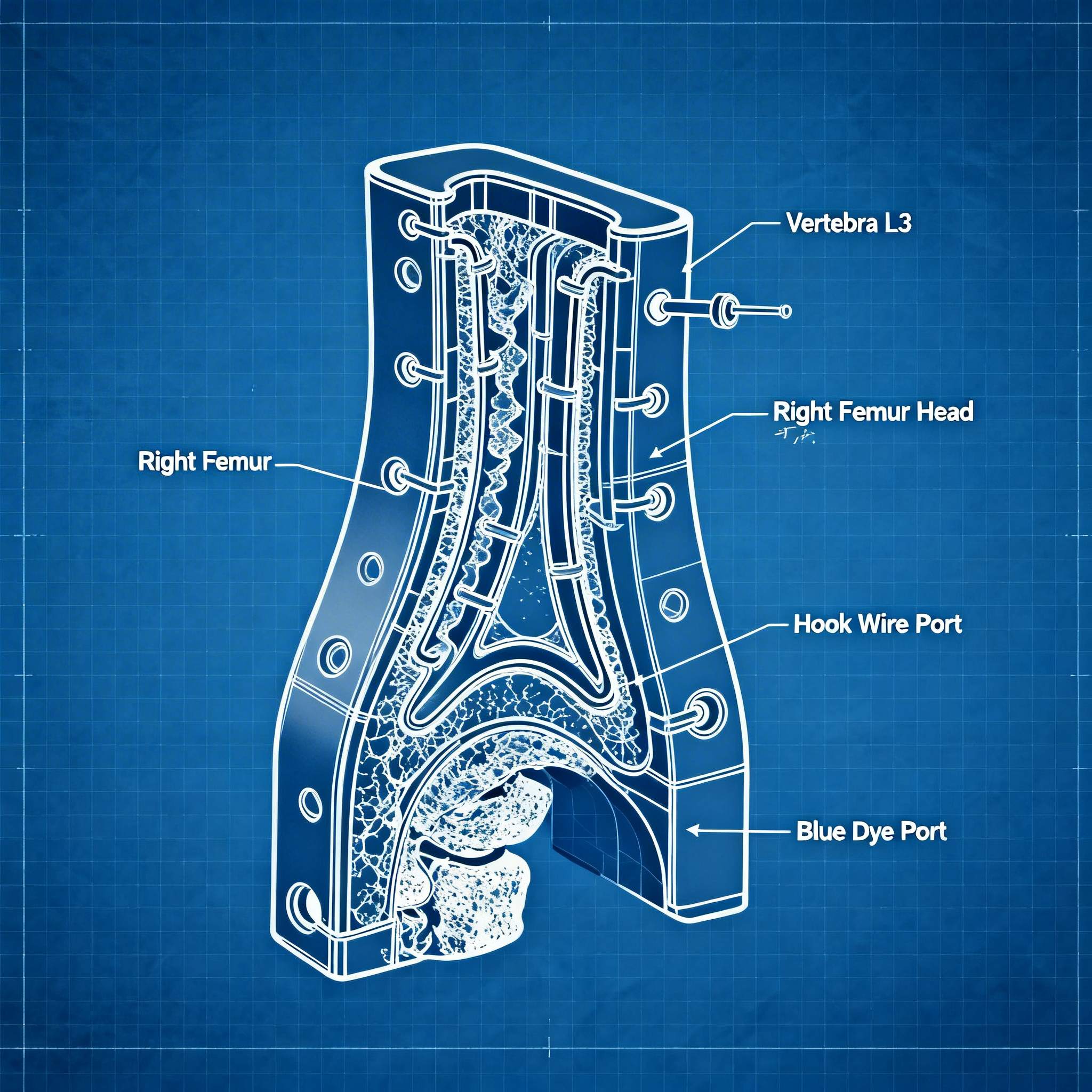
The device integrates several strategically positioned functional openings: small holes on the surface allow the surgeon to trace the projected outline of the tumor on the skin, while a central cylindrical port allows the insertion of a guide wire (hook wire) directly into the lesion. Additional lateral ports are designed for the injection of blue dye columns approximately 1 cm from the margins defined at the resonance, creating intraparenchymal visual references that guide the resection.
Biocompatible Materials and 3D Printing Process
The use of biocompatible polymers and 3D printing allows for the rapid and safe production of certified single-use medical devices.
The Breast Cancer Locator is produced using 3D printing technologies with biocompatible polymers specifically selected for skin contact and to withstand sterilization processes. The choice of materials must meet rigorous safety requirements, ensuring the absence of allergic or toxic reactions during clinical use.
For the European market, production is entrusted to Amnovis, a company specialized in medical 3D printing that manages certified workflows for medical devices. This distributed approach leverages the logic of additive manufacturing: digital files are transmitted to the production partner, who manufactures the device on-demand, drastically reducing delivery times compared to traditional production. The low cost of 3D printing – comparable to 30 cents per unit for other printed surgical devices – makes full customization economically sustainable.
Quality Control and Sterilization
Each guide is dimensionally verified and sterilized to ensure safety and compliance with medical standards before intraoperative use.
Before delivery, every printed device undergoes rigorous quality controls. Dimensional verification typically occurs via optical scanning, which compares the physical device with the original digital model to ensure correspondence within specified tolerances. This step is crucial to ensure that the guide fits the patient's anatomy perfectly and that the openings are positioned with the necessary precision.
After dimensional validation, the device is sterilized according to standard protocols for single-use medical devices. Traceability requirements mandate complete documentation of every production phase, from receipt of images to delivery of the sterilized device, ensuring compliance with European and US regulations for customized medical devices.
Clinical Application and Benefits for the Surgeon
During the intervention, the guide allows for precise injection into the target region, improving oncological margins and reducing operative times.
In the operating room, the surgeon positions the guide on the patient's breast, aligning it with anatomical references. The perfect adherence ensures that the device openings correspond exactly to the three-dimensional position of the tumor identified on the MRI. Through the surface holes, the surgeon traces the outline of the lesion on the skin, creating an immediate visual map.
The central port allows for guided insertion of the guide wire inside the tumor, while the lateral ports allow for the injection of blue dye into surrounding tissues at a predefined distance from the margins. These multiple references – superficial and deep – provide the surgeon with a complete three-dimensional guidance during resection.
In pilot clinical studies conducted on 19 patients, the system demonstrated accuracy in tumor localization. The main objective is to obtain negative surgical margins at the first intervention, reducing the need for re-interventions that involve additional stress for the patient and high costs for the healthcare system. Ongoing randomized trials are evaluating parameters such as the percentage of positive margins, the need for re-intervention, and the amount of healthy tissue removed.
Conclusion
Custom 3D surgical guides are redefining the precision of oncological interventions, combining advanced imaging, digital engineering, and certified additive manufacturing. The Breast Cancer Locator by Cairn Surgical exemplifies how medical 3D printing can transform diagnostic data into physical tools that concretely improve surgical outcomes. This approach, which integrates MRI acquisition in the operating position, patient-specific design, biocompatible materials, and rigorous quality controls, represents a replicable model for other applications in conservative oncological surgery.
Learn how imaging and digital production technologies are revolutionizing conservative surgery and discover innovations in the customization of medical devices.
article written with the help of artificial intelligence systems
Q&A
- What is the main function of the Breast Cancer Locator by Cairn Surgical?
- The Breast Cancer Locator is a custom 3D surgical guide that improves the precision of lumpectomies. It allows surgeons to accurately locate breast tumors with millimetric precision during conservative interventions, thanks to a device created from the patient's magnetic resonance imaging.
- Why is it important to acquire MRI in the surgical position?
- Acquiring MRI in the surgical position is crucial because it ensures that the 3D model faithfully reflects the anatomy of the breast as it will appear in the operating room. This avoids distortions due to gravity or positioning and improves the accuracy of the guide.
- How is the custom guide designed and what openings does it have?
- The guide is designed as a plastic shell that fits perfectly to the shape of the breast, based on the anatomical references identified in the MRI. It includes superficial holes to trace the skin contour of the tumor, a central port for the insertion of the guide wire, and lateral ports to inject blue dye at a defined distance from the tumor margins.
- What materials are used for the production of the device and who handles it in Europe?
- The device is made with selected biocompatible polymers for skin contact and sterilization. In Europe, production is entrusted to Amnovis, a company specialized in medical 3D printing, which follows certified workflows for customized medical devices.
- What advantages does the guide offer during the surgical intervention?
- During the intervention, the guide allows for precise injection of the guide wire and blue dye, providing both superficial and intraparenchymal visual references. This enables the surgeon to remove the tumor with greater accuracy, improving oncological margins and reducing operative times and the need for re-interventions.